By Paul G.
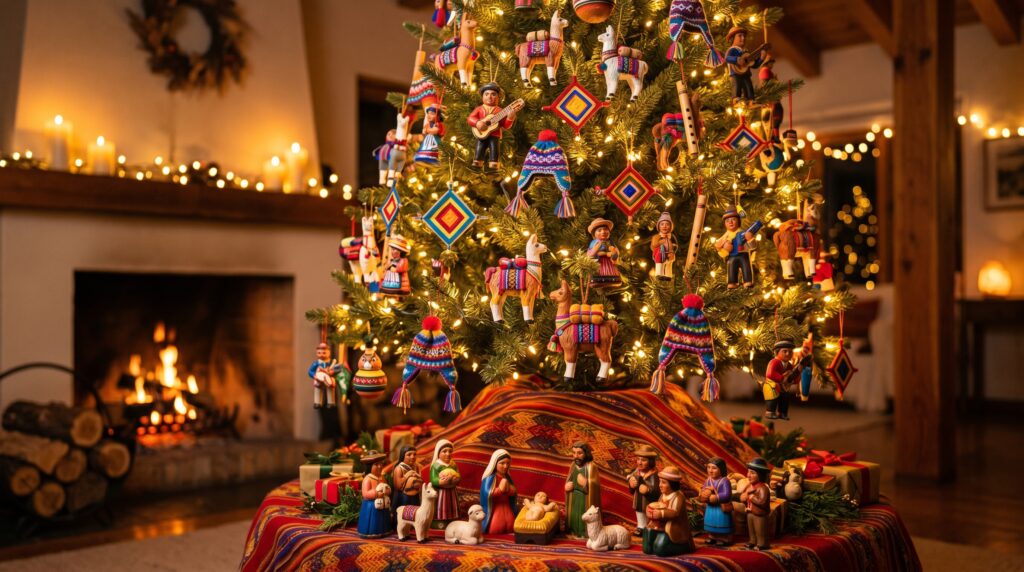
If you’ve ever seen a Peruvian Christmas tree, you noticed something different. There are still lights and tinsel and the usual ornaments you’d expect. But mixed in are tiny carved llamas wearing little blankets. Miniature musicians playing pan flutes. Hand-painted geometric stars from the highlands. And at the base, instead of a felt tree skirt, there’s a handwoven Andean textile in deep red and ochre.
The Peruvian Christmas tree is what happens when European tradition meets Andean craft. The tree itself came from Europe. Everything on it and around it has been Peruvian-ified.
Here’s how the Christmas tree works in Peru, what we put on it, and how to do a Peruvian-style tree in your own home if you want to.
A short history of the Christmas tree in Peru
Christmas trees aren’t originally Peruvian. They came to Peru in the late 1800s with European immigration, especially German and Italian families who settled in coastal cities like Lima. The tradition slowly spread inland, and by the mid-1900s, most middle-class urban families had a tree.
Today, almost every Peruvian household has a Christmas tree. But here’s a thing that’s specific to Peru: real evergreen trees are rare. There aren’t many natural pine forests in most of Peru, especially in the coastal cities. So almost every Peruvian Christmas tree is artificial. We’ve been doing artificial trees in Peru long before they became a sustainability conversation in the US.
This is also why the tree often isn’t the centerpiece in a Peruvian household. The nacimiento (nativity scene) is more important. The tree is decoration. The nacimiento is the religious and cultural center of Christmas.
How a typical Peruvian family decorates the tree
Most Peruvian families set up the tree the first weekend of December. The tree goes in the living room, in a corner or by a window. The nacimiento goes at the base of the tree, on a small table or directly on the floor, set up first.
Decoration happens with the kids. The ornaments are usually a mix of three things:
- Standard imported ornaments (the round colored balls, ribbons, lights, tinsel)
- Handmade Peruvian ornaments (more on these below)
- Family heirloom pieces that get pulled out of a box every year and added to the tree
The lights are usually warm white or multicolored, often LED these days. Some families go heavy on tinsel (especially older households). The top of the tree usually has a star or an angel.
At the base of the tree: the nacimiento, set up on or around a handwoven Andean textile that acts as a tree skirt. (More on the textile option below.) Read more about Peruvian Christmas decorations including nacimientos and retablos if you want the full picture.
Handmade Peruvian Christmas tree ornaments
This is what makes a Peruvian Christmas tree look distinctly Peruvian. Hand-carved wooden ornaments, hand-painted in bright traditional colors, hanging alongside the standard ornaments. Common shapes:
- Llamas with embroidered or painted blankets on their backs
- Tiny chullos (the Peruvian knit hat) with patterns
- Quechua villagers in traditional dress (ponchos, knit hats, sashes)
- Musicians playing zampoñas, charangos, or quenas
- Geometric stars and crosses with Andean patterns
- Tiny manger scenes
- Alpacas, sheep, and condors as natural Andean animals
- Ceramic angels dressed in Andean clothing
The colors are unmistakable: deep red, ochre yellow, sky blue, forest green, all painted by hand. Each ornament is slightly different because they’re handmade. That’s the look.
These ornaments are mostly produced in Cusco and the surrounding artisan towns. The Santurantikuy market in Cusco’s main plaza on December 24 is the biggest single place to buy them, but you’ll find them in markets across the Andean region year-round.
How many do you need for a Peruvian-style look?
You don’t have to commit to a full Peruvian tree to get the look. Adding even 6 to 10 handmade Peruvian ornaments to your existing tree changes the whole feel. Mix them in with the standard ones. Spread them out, not clustered. The result is a tree that’s still familiar but distinctly Andean.
If you want to go all-in, you can replace most or all of your tree’s ornaments with handmade Peruvian ones. Households in the Andean highlands sometimes do this. The result is a fully Andean Christmas tree that’s beautiful and unlike anything else.
Going Peruvian this Christmas?
If you’re looking to add Peruvian craft to your home this holiday (beyond ornaments), our Christmas Gifts collection has handmade pieces from Cusco artisans. Bull horn flasks, Machu Picchu sculptures, hand-carved leather. They work as gifts or as accents for a Peruvian Christmas setup.
The Peruvian Christmas tree skirt: handwoven Andean textile
In most Peruvian households, the “tree skirt” is actually a handwoven Andean textile. Not a felt skirt with embroidered reindeer on it. A real woven cloth in deep colors with traditional geometric patterns.
The textile gets wrapped around the base of the tree, or laid flat under the nacimiento. The colors are usually red, ochre, indigo, with geometric patterns that have roots going back thousands of years to pre-Inca weaving traditions.
The advantage of this kind of tree skirt: it works year-round. After Christmas, the textile becomes a normal home decoration. You can use it as a table runner, a throw, or a wall hanging. So you’re not buying something that lives in a box 11 months out of the year.
Where to find an authentic one
Look for handwoven in Peru, ideally with the region named (Chinchero, Pisac, Cusco, Puno). Avoid factory-printed “Peruvian-style” textiles, which are mass-produced and don’t have the weight or character. A real handwoven textile feels heavier and has slight irregularities in the weave.
Pricing varies. A simple smaller piece might be $30-50. A bigger, more elaborate weaving with natural-dye colors and complex patterns can run $150-300+. Both work as tree skirts depending on your tree size and how the wrapping looks.
Tree toppers: star, angel, or something Peruvian
Most Peruvian trees still use a standard tree topper, either a star or an angel. Some families with strong Andean leanings will use a Peruvian-style topper instead. Options you’ll see in Cusco markets:
- A hand-painted Andean star with traditional geometric patterns
- A ceramic angel in Andean clothing (knit chullo and poncho)
- A small retablo mounted on top (the wooden box that opens to a religious scene)
- A Niño Manuelito figure (Peruvian baby Jesus) as the topper
If you want a fully Peruvian Christmas tree but only want to swap one element, the tree topper is a good place to start. Easy to find, dramatic change in look.
How to bring a Peruvian feel to your existing tree
If you don’t want to overhaul your whole tree, you can get most of the Peruvian look with just a few additions. The easiest path:
Minimum effort, big visual change
- Add 6-10 handmade Peruvian ornaments mixed in with your existing ones
- Wrap a handwoven Andean textile around the base as a tree skirt
- Put a nacimiento at the base if you have one (or want one)
That’s three changes. The tree still feels like your tree, but it has a Peruvian character to it that nobody else’s tree has.
Going all-in
- Replace most ornaments with handmade Peruvian ones
- Add a Peruvian tree topper (Andean star, ceramic angel in chullo, or small retablo)
- Use a handwoven textile as the skirt
- Set up a full nacimiento at the base
- Add a few candles or warm string lights nearby for the highland cozy feel
Where to find Peruvian Christmas tree decorations online
If you’re not flying to Cusco anytime soon, here’s how to find the real stuff online:
- Sellers who specifically say “handmade in Peru”, ideally with the region named (Cusco, Ayacucho, Pisac, Chinchero)
- Photos that show variations between pieces (handmade pieces are never identical)
- Story about the artisan workshop (sellers who work directly with artisan families usually mention this)
- Higher prices that reflect actual handmade labor
Avoid:
- Listings that say “Peruvian style” but not “made in Peru” (usually mass-produced in factories elsewhere)
- Identical photos across multiple sellers (same factory product)
- Suspiciously low prices for what should take a day of carving and painting
Peruvian Christmas Tree FAQ
Do Peruvians have Christmas trees?
Yes. Almost every Peruvian household has a Christmas tree. The tradition came with European immigration in the late 1800s. Trees are usually artificial because real evergreens are rare in most of Peru. The tree is decoration; the more important Christmas centerpiece in most Peruvian households is the nacimiento (nativity scene).
What’s a Peruvian Christmas tree topper?
Most Peruvian trees still use a standard star or angel. For a more Peruvian feel, some families use hand-painted Andean stars, ceramic angels in traditional Andean clothing (chullo and poncho), small retablos, or Niño Manuelito figures (the Peruvian baby Jesus).
What kind of ornaments go on a Peruvian Christmas tree?
A mix. Standard imported ornaments (balls, lights, tinsel) plus handmade Peruvian ornaments hand-carved from wood and painted in bright Andean colors. The Peruvian ornaments commonly include llamas, tiny chullos, Andean villagers, musicians, geometric stars, and small manger scenes.
Do Peruvians use a tree skirt?
Yes, but instead of the standard felt tree skirt, most Peruvian households use a handwoven Andean textile wrapped around the base of the tree. Deep red, ochre, indigo colors with traditional geometric patterns. The advantage is it works year-round as home decor, not just at Christmas.
Where can I buy Peruvian Christmas tree ornaments?
The biggest single source in Peru is the Santurantikuy market in Cusco’s main plaza on December 24. Year-round, the regular Cusco markets and the Pisac Sunday market have them. Online, look for sellers who specifically say handmade in Peru, ideally with the region named, and who show variations between pieces (a sign of real handmade work).
Are Peruvian Christmas trees real or artificial?
Almost always artificial. Real evergreens are rare in most of Peru, especially in coastal cities. Artificial trees have been the norm in Peruvian households for decades.
Make your Christmas tree a little more Peruvian this year
A few handmade ornaments and a handwoven textile at the base. That’s all it takes to give your tree a Peruvian character that nobody else’s tree has. And those pieces last for years; they become part of your annual tradition, the same way they are in Peru.
For the full picture of Peruvian Christmas (food, music, traditions, decorations beyond the tree), read our complete guide to Peruvian Christmas. And if you want handmade Peruvian gifts for the holiday, browse our Christmas Gifts collection.
Feliz Navidad.