By Paul G.
If you’ve been to a Christmas Eve in the Andes, you’ve heard music that doesn’t sound like any other Christmas music in the world. Charango. Bamboo flutes. Pan flutes. Drums made from boxes. Lyrics in Quechua. Melodies that go back hundreds of years.
Peruvian Christmas music is its own thing. It has Catholic roots (because the Spanish brought Christmas to Peru in the 1500s), but the sound is fully Andean. The result is Christmas carols you can’t hear anywhere else.
Here’s the full picture. What makes Peruvian Christmas music distinct, the instruments it’s played on, the famous songs, where to listen, and one really specific reference you might have heard in a Hollywood movie.
What is a villancico?
A villancico is a Christmas carol. Originally from medieval Spain, the form spread across the Spanish-speaking world during the colonial period. So you’ll find villancicos in Mexico, Colombia, Argentina, Spain, the Philippines, everywhere Spanish missionaries went.
In Peru, villancicos got reshaped to sound Andean. Indigenous Quechua and Aymara musicians took the Catholic Christmas lyrics, set them to traditional Andean melodies, and played them on traditional Andean instruments. The result was a brand new musical form that’s both Catholic and indigenous at the same time.
Today, Peruvian villancicos get sung in churches, taught in schools, performed in plazas during December, and played at home gatherings. They’re a real part of Peruvian Christmas culture, not just background music.
Why Peruvian Christmas music sounds different
Three things make Peruvian Christmas music distinct from Spanish or American Christmas music.
1. Andean melodies
Most Peruvian villancicos are built on top of the huayno structure. Huayno is the traditional musical form of the Peruvian Andes, dating back centuries before the Spanish arrived. It has a distinctive rhythm (a kind of skipping triple meter) and a melodic structure that’s different from European music.
When you put Christmas lyrics on top of a huayno, you get a Christmas song that sounds nothing like “Silent Night” or “Jingle Bells.” The melody bounces. The rhythm has a different pulse. It sounds like the highlands.
2. The language: Quechua, Aymara, and Spanish mixed
In the Andean highlands around Cusco, Puno, and Ayacucho, villancicos are often sung in Quechua (the language of the Inca empire, still spoken by millions of Peruvians today). Or they mix Spanish and Quechua in the same song.
When you hear a Peruvian villancico with Quechua lyrics, the sound is unmistakable. Quechua has its own rhythm and consonants that give the melody a character you can’t get in Spanish or English.
In the Aymara-speaking regions around Lake Titicaca, you’ll also hear villancicos in Aymara. Same effect: a Christmas song that sounds completely indigenous.
3. Traditional Andean instruments
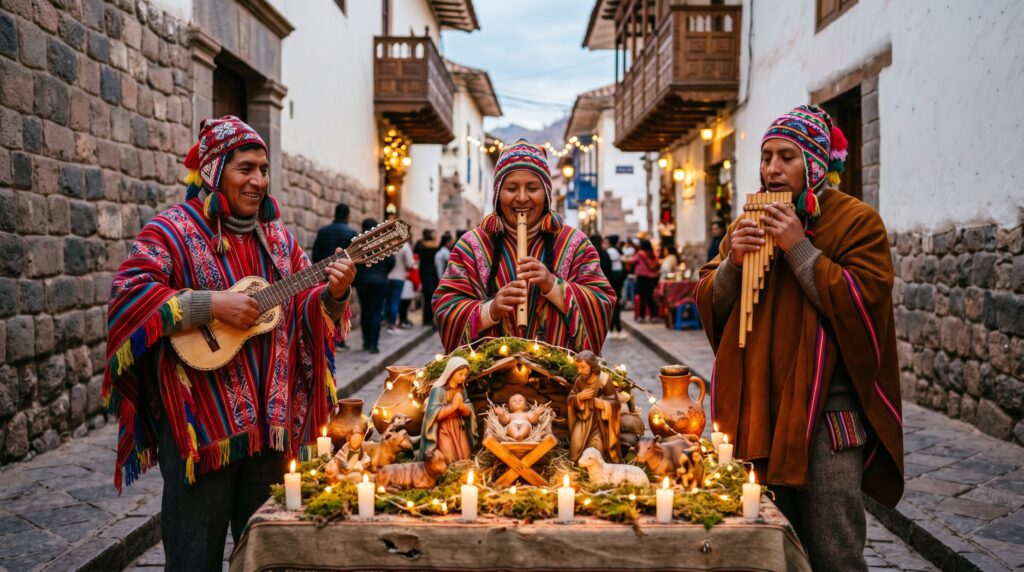
Peruvian villancicos are usually performed with traditional Andean instruments. Four show up most often:
- Charango: A small 10-string instrument, originally made from an armadillo shell (today usually wood). It looks like a tiny guitar and sounds bright and percussive. The charango is the lead melodic instrument in most Andean Christmas music.
- Quena: A vertical bamboo flute. One of the oldest instruments in the Andes. Plays melancholy, breathy melodies. Carries the higher melodic lines in villancicos.
- Zampoña (siku): The pan flute. Multiple bamboo tubes of different lengths bound together. Plays in a distinctive trading-notes style where two zampoña players pass the melody back and forth.
- Bombo or cajón: A drum. Bombo is a large hand-played drum native to the Andes. Cajón is the box-drum that originated on the Peruvian coast and is now famous worldwide.
When you hear those four together playing a Christmas song, that’s a Peruvian villancico.
Famous Peruvian villancicos
A few villancicos are universally known in Peru. Kids learn them in school. They get played at Christmas Eve gatherings. They show up in church services.
Niño Manuelito
Named after the uniquely Peruvian baby Jesus figure (full context in our decorations post). “Niño Manuelito” is one of the most beloved villancicos in Peru, with Quechua and Spanish versions both popular. The melody is gentle and lullaby-like.
Hatun Apu Yaya
A Quechua-language villancico. The title roughly translates to “Great Lord Father.” Performed often in Andean churches and during community Christmas celebrations. Distinctly highland in its melody and instrumentation.
Cantemos un Villancico
A more upbeat Spanish-language song meaning “Let’s Sing a Christmas Carol.” Played in schools and at family gatherings. The rhythm makes it easy to clap along to.
Yo Soy Vicentico
“I am Little Vincent.” A lighter children’s villancico from Peru that’s been recorded by many artists. Common at school Christmas programs.
Pastorcita
A traditional villancico about the shepherds visiting the baby Jesus. Multiple regional versions exist across Peru, each with slightly different melodies.
The Hollywood reference: “Christmas with the Kranks”
Here’s a specific one a lot of Americans might have heard without realizing where it came from. In the 2004 movie Christmas with the Kranks (with Tim Allen and Jamie Lee Curtis), there’s a scene where a Peruvian Christmas song plays in the background.
The song is “Mi Burrito Sabanero” (“My Little Donkey from the Plains”), which is actually originally Venezuelan, not Peruvian, but it’s widely sung throughout Latin America including Peru. The movie mistakenly identifies it as Peruvian, but it became one of the most recognizable Latin American Christmas songs in American pop culture as a result.
So if you’ve ever wondered “what’s that Peruvian Christmas song from Christmas with the Kranks?” — it’s “Mi Burrito Sabanero,” technically Venezuelan, widely sung in Peru and across Spanish-speaking Latin America.
Want a piece of Peru for your home this holiday?
If you’re into Andean culture and looking for a handmade Peruvian gift or decor piece this Christmas, our Christmas Gifts collection has hand-carved pieces from Cusco artisans. Some traditions you bring home in a song. Others you bring home as a sculpture or a leather bag.
Where you actually hear Peruvian Christmas music live
The single best place to hear Peruvian Christmas music live is in Cusco during December. Specifically, the Santurantikuy market in Cusco’s main plaza on December 24.
Santurantikuy is the biggest Christmas artisan market in South America. The name means “buying of saints” in Quechua. Artisans come from across the southern Andes to sell handmade nativity figures, retablos, and decorations. And the whole plaza fills with live villancicos. Charango players. Pan flute groups. Some sing in Quechua, some in Spanish. It’s been happening for centuries.
Outside of December, you hear Andean Christmas music in churches across the highlands (especially Cusco, Ayacucho, Puno), in school nativity plays in November and December, and at private family gatherings on Christmas Eve. Lima also has Christmas concerts, but the Andean villancicos sound most authentic in their home region.
Regional differences in Peruvian Christmas music
Coastal music (Lima)
On the coast, Christmas music leans more European and Spanish-influenced. Standard Spanish-language villancicos are common. Cajón (the box drum) shows up in folkloric performances. Latin-American Christmas standards (like “Mi Burrito Sabanero,” “Feliz Navidad,” etc.) play in malls and on radio. It’s culturally Christmas, just less Andean.
Andean music (Cusco, Puno, Ayacucho)
In the highlands, the Andean tradition dominates. Villancicos in Quechua. Traditional instruments. Huayno-based melodies. School Christmas programs in the Andes often have kids in traditional dress performing dances and singing in Quechua. Christmas Mass in places like the Cusco cathedral includes Andean villancicos sung by community choirs.
Amazonian music (Iquitos, Pucallpa)
In the jungle regions, Christmas music has its own flavor. Indigenous Amazon communities incorporate their own traditional music into Christmas celebrations. Lighter percussion. Flute-based melodies that are different from the highland sound. Sometimes accompanied by mestizo (mixed indigenous-Spanish) musical traditions of the jungle cities.
Where to actually listen to Peruvian Christmas music
If you want to hear Peruvian Christmas music from outside Peru, there are a few good ways to find it.
YouTube
Search for any of these and you’ll get hours of Peruvian villancicos:
- “Villancicos peruanos” (Peruvian Christmas carols)
- “Villancicos quechua” (Quechua-language villancicos)
- “Villancicos andinos” (Andean Christmas carols)
- “Niño Manuelito villancico”
- “Christmas en Cusco” or “Navidad cusqueña”
Look for recordings from groups like Los Kjarkas, Wayna Picchu, or local Cusco choirs. The recordings from actual Andean musical groups tend to sound the most authentic.
Spotify and Apple Music
Search “Villancicos Peruanos” or “Villancicos Andinos” and several playlists come up. Spotify has a few good ones with anywhere from 30 to 100 songs. Apple Music has similar collections. These are good for putting on during your own Christmas Eve dinner if you want some real Peruvian Christmas atmosphere.
If you’re in Peru
Just go outside in December. You’ll hear it. Cusco especially. Smaller mountain towns like Pisac, Chinchero, and Ollantaytambo also have Christmas community events with live music.
Peruvian Christmas Music FAQ
What’s a villancico?
A villancico is a Christmas carol. The form originated in medieval Spain and spread across the Spanish-speaking world. In Peru, villancicos got reshaped with Andean melodies, traditional instruments, and often Quechua lyrics.
What language are Peruvian Christmas songs in?
It depends on the region. On the coast (Lima), villancicos are mostly in Spanish. In the Andean highlands (Cusco, Puno, Ayacucho), they’re often in Quechua or a mix of Quechua and Spanish. In the Lake Titicaca region, some are in Aymara.
What instruments are used in Peruvian Christmas music?
The four main Andean instruments: charango (small stringed instrument), quena (bamboo flute), zampoña (pan flute), and bombo or cajón (drum). Coastal villancicos sometimes use guitar instead.
What’s the Peruvian Christmas song in “Christmas with the Kranks”?
The song in the 2004 movie is “Mi Burrito Sabanero” (“My Little Donkey from the Plains”). The movie identifies it as Peruvian, but it’s actually originally Venezuelan. That said, it’s widely sung throughout Peru and across Spanish-speaking Latin America as a Christmas standard.
Where can I hear Peruvian Christmas music online?
YouTube and Spotify both have plenty. Search for “villancicos peruanos,” “villancicos andinos,” or “villancicos quechua.” Specific songs to look for: “Niño Manuelito,” “Hatun Apu Yaya,” “Cantemos un Villancico.”
What’s Santurantikuy?
Santurantikuy is the biggest Christmas artisan market in South America, held in Cusco’s main plaza on December 24. Live villancicos are performed throughout the day by Andean musicians playing charango, quena, and zampoña. It’s the best place in the world to experience Peruvian Christmas music live.
Bring the sound of Peruvian Christmas into your own holiday
Even if you’re nowhere near Peru, you can put on a Quechua villancico playlist during your Christmas Eve dinner and the whole vibe changes. Try “Niño Manuelito” or any of the recordings on a Cusco-style villancicos playlist. The melodies are different. The instruments are different. The feeling carries through.
For the rest of the picture (the food, the traditions, the decorations), read our complete guide to Peruvian Christmas. And if you want a handmade Peruvian gift for someone this holiday, browse our Christmas Gifts collection.
Feliz Navidad. Sumaq Pascua.