By Paul G.
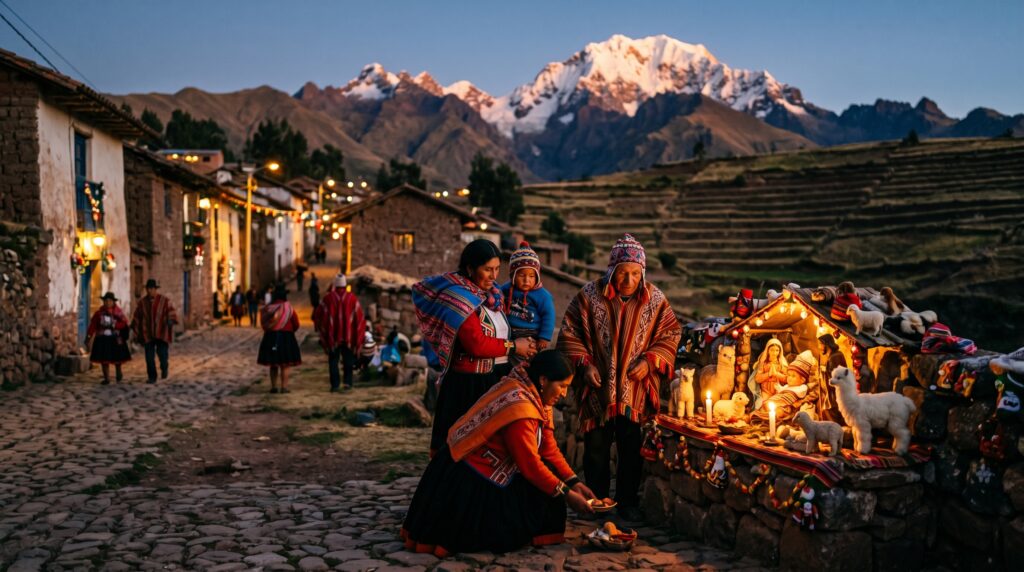
Go to a Christmas Eve service in a Peruvian highland village and you’ll notice something. The hymns are in Quechua. The baby Jesus in the nativity scene wears a tiny chullo hat. The Wise Men are dressed in Andean clothing. Llamas stand next to the manger instead of donkeys.
This is Andean Christmas. A version of Christmas that has Catholic roots but indigenous Andean soul. It’s been this way for over 500 years, since the Spanish first arrived. And it’s still alive in towns across the Peruvian highlands, in parts of Bolivia, Ecuador, and beyond.
Here’s what makes Andean Christmas different, where it comes from, and how to recognize it when you see it.
What “Andean” means in this context
“Andean” refers to the cultures of the Andes mountains, which stretch down the western side of South America from Colombia and Venezuela through Ecuador, Peru, Bolivia, parts of Chile and Argentina. Peru is the historical heartland of the Andean world. The Inca empire was based here, and before the Inca, dozens of other civilizations (Wari, Chavín, Moche, Nazca, Tiwanaku) developed across the same mountains.
The Andean peoples today are mostly descendants of these civilizations. The Quechua-speaking population (about 4-5 million in Peru alone) is the largest indigenous group. Aymara speakers around Lake Titicaca are another major group. These cultures have their own languages, their own traditions, their own art, their own foods, and their own spiritual practices that go back thousands of years.
When we say “Andean Christmas,” we mean Christmas as practiced specifically in these Andean cultures. It overlaps with Peruvian Christmas (you can read more in our complete guide to Peruvian Christmas), but it’s more specific. Coastal and Amazonian Peruvian Christmas is different. Andean Christmas is the version that happens up in the mountains.
How Catholic Christmas merged with Andean tradition
When the Spanish conquered the Inca empire in the 1530s, they brought Catholic Christianity with them. Missionaries spread out across the Andes, building churches in indigenous communities and teaching the Catholic calendar including Christmas (Navidad).
But the Andean peoples didn’t just adopt European Christmas wholesale. They reshaped it with their own materials, their own aesthetics, and their own existing spiritual concepts. Indigenous artisans began carving Catholic religious figures using local techniques and styles. Catholic feast days got blended with older indigenous celebrations that fell on or near the same dates. Quechua became a language for prayer and song alongside Spanish.
The result is a fully syncretic religious tradition. It’s genuinely Catholic and genuinely Andean at the same time. Neither side replaced the other. They merged.
Cápac Raymi: the Inca December festival that overlapped with Christmas
Here’s one piece of context most people miss. In the Inca empire, the most important December festival was called Cápac Raymi (sometimes spelled Qhapaq Raymi). It was the second-largest religious celebration of the Inca year (after Inti Raymi in June).
Cápac Raymi fell around the December solstice (which is the summer solstice in the southern hemisphere) and celebrated several things at once: the sun at its strongest point, agricultural abundance, and especially the coming-of-age ceremonies for young Inca nobility. Ceremonial dances, music, animal sacrifices, and major feasts were all part of the celebration.
When Spanish missionaries arrived and tried to replace Cápac Raymi with Christmas, what actually happened was a partial blending. The Catholic religious meaning of Christmas (birth of Jesus) became dominant, but a lot of the December celebratory energy from Cápac Raymi (feasting, music, family gathering, the sense that this is the year’s big midsummer party) carried forward into how Andean communities celebrate Christmas today.
That’s why Andean Christmas feels so big. It’s not just Catholic Christmas. There’s a much older indigenous celebratory tradition running underneath.
What makes Andean Christmas visually and culturally distinct
Six things show up in Andean Christmas that you won’t see in coastal Peruvian, European, or American Christmas:
1. Niño Manuelito in Andean clothing
Niño Manuelito is the specifically Peruvian Andean baby Jesus figure. In the highlands, he’s almost always shown wearing a chullo (the Peruvian knit hat), often with a tiny poncho or sash. Some families have a Niño Manuelito that’s been in the family for generations. Some families change his outfit several times during the Christmas season for different feast days.
2. Llamas and alpacas in the nacimiento
The traditional Catholic nativity scene has a donkey and an ox in the stable. In Andean nacimientos, those animals are usually replaced or supplemented with llamas and alpacas, which are the actual animals of the highland regions. The shepherds are often dressed in traditional Quechua or Aymara clothing, and the Wise Men might be carrying Andean musical instruments like charangos or pan flutes.
3. Quechua villancicos and Andean music
Peruvian Christmas music in the Andean highlands is sung in Quechua, often using the traditional huayno musical structure (which is native to the Andes). The melodies sound nothing like “Silent Night.” The instruments (charango, quena, zampoña, bombo) are pre-Columbian. The result is a Christmas musical tradition that exists nowhere else in the world.
4. Hand-carved retablos and nacimientos
Andean Christmas decorations are mostly handmade. Hand-carved wooden figures. Molded ceramic retablos from Ayacucho. Hand-painted ornaments. Almost nothing is mass-produced. The aesthetics are bright colors, geometric patterns, and a folk-art sensibility that comes directly from indigenous Andean art traditions.
5. Mass in Quechua
In some Andean churches, especially in rural communities, Christmas Mass is partly or fully conducted in Quechua rather than Spanish or Latin. The hymns are Quechua villancicos. The prayers might be bilingual. The result is a Catholic Mass that sounds, looks, and feels distinctly indigenous.
6. Communal celebrations
In many Andean villages, Christmas is more communal than in coastal or urban areas. The whole village often participates in the same nativity play, the same procession, the same midnight Mass. Christmas Eve dinners are often community potlucks rather than private family affairs. The sense of ayni (Quechua for mutual aid and reciprocity, a core Andean cultural value) carries through how Christmas is celebrated.
Want to bring some Andean craft into your own holiday?
Most of what makes Andean Christmas distinct is the handmade craft. The carved figures, the hand-woven textiles, the leather work. If you want a piece of that for your own home or as a gift, our Christmas Gifts collection has handmade pieces from artisans in Cusco. Same craft tradition, shipped directly to your door.
Santurantikuy: the most concentrated Andean Christmas experience
If you want to see Andean Christmas at its most concentrated, the place to go is Santurantikuy in Cusco. Held in the main plaza on December 24, Santurantikuy is the largest Christmas artisan market in South America. The name means “buying of saints” in Quechua.
Artisans come from across the southern Andes specifically for this one day market. They sell handmade nativity figures, retablos, Niño Manuelitos in tiny Andean clothing, hand-painted Christmas ornaments, woven textiles, and traditional crafts. Live villancicos play in the background, mostly in Quechua. The smell of food (warm hot chocolate, panetón, anticuchos) fills the plaza.
Santurantikuy has been happening in Cusco for centuries. It’s one of the most authentic expressions of Andean Christmas you can witness anywhere.
Modern Andean Christmas: keeping traditions alive
Like indigenous cultures everywhere, Andean communities have to navigate between maintaining their traditions and engaging with the modern world. Andean Christmas is part of that ongoing negotiation.
In bigger Andean cities like Cusco, Christmas is a mix. Standard Christmas (lights, malls, imported decorations) coexists with traditional Andean Christmas (Santurantikuy, Quechua villancicos, traditional clothing on Christmas Eve). Most families do some of both.
In smaller villages and rural Quechua communities, the traditional version is much stronger. Younger generations growing up in these communities are taught traditional Christmas songs, dances, and customs alongside whatever they pick up from television and the internet. There’s a real effort to keep the indigenous traditions alive.
There’s also been a growing movement in Peru in recent decades to teach Quechua more widely, to elevate indigenous artisans, and to celebrate Andean Christmas specifically as a cultural inheritance worth maintaining. Festivals like Santurantikuy have grown larger and more visible. Recordings of Quechua villancicos get wide distribution on streaming services. Handmade Andean Christmas decorations have a global market now in ways they didn’t 30 years ago.
Why Andean Christmas matters beyond the Andes
You don’t have to be from the Andes or have Andean heritage to appreciate or learn from Andean Christmas traditions. Some of what makes Andean Christmas distinct (the emphasis on handmade craft, the communal celebration, the layered cultural meanings) are values that translate.
Adding a few handmade Andean ornaments to your tree, learning a Quechua phrase like “Sumaq Pascua,” cooking a piece of a Peruvian Christmas Eve dinner, or listening to villancicos in Quechua during your own holiday season are all ways to engage with this tradition respectfully and meaningfully.
Andean Christmas FAQ
What’s the difference between Andean Christmas and Peruvian Christmas?
Peruvian Christmas includes all of Peru: coastal, Andean, and Amazonian. Andean Christmas specifically refers to Christmas in the Andean highlands of Peru, Bolivia, Ecuador, and beyond, where indigenous Quechua and Aymara traditions blend most heavily with the Catholic celebration. Andean Christmas is one part of Peruvian Christmas.
What language is Andean Christmas celebrated in?
Often Quechua, the main indigenous language of the Andes (4-5 million Peruvian speakers). Sometimes Aymara in the Lake Titicaca region. Most modern Andean Christmas celebrations are bilingual, mixing Quechua and Spanish.
What was Cápac Raymi?
Cápac Raymi was a major Inca religious festival held around the December solstice (which is the summer solstice in the southern hemisphere). It was the second-most important Inca celebration of the year, focused on coming-of-age rites for young nobility and on celebrating the sun at its strongest point. After Spanish colonization, much of the December celebratory tradition associated with Cápac Raymi got blended into how Andean communities celebrate Christmas today.
Why are llamas in the Peruvian nativity scene?
Because the Andean nacimiento adapts the traditional Catholic nativity scene to the actual environment of the Andes. In the highlands, llamas and alpacas are the working animals, not donkeys and oxen. So Andean nativity figures include them naturally. It’s part of how Catholic Christmas was indigenized.
Can I visit Andean Christmas as a tourist?
Yes. Cusco is the most accessible place to experience Andean Christmas, especially the Santurantikuy market on December 24. Smaller villages like Pisac, Chinchero, and Ollantaytambo also have community Christmas events that are open to respectful visitors. Travel agencies in Cusco can connect you with specific local experiences if you want a deeper cultural immersion.
How can I learn more about Andean culture beyond Christmas?
Beyond Christmas, look into Andean music (Los Kjarkas, Wayna Picchu, Inkari), Quechua language resources (there are online courses), Peruvian highland cuisine, and the work of Peruvian Indigenous-rights organizations. Visiting the Andes outside of December also gives you a fuller picture of the culture year-round.
Andean Christmas, wherever you are
Andean Christmas is what happens when a 1,500-year-old indigenous tradition meets a 500-year-old Catholic one. Both are still alive in it. That’s why it feels different from any other Christmas in the world. The food, the music, the figures in the nativity scene, the language of the hymns — every part of it carries both stories.
Read our complete guide to Peruvian Christmas for the full picture. Or if you want to bring some Andean craft into your own holiday, browse our Christmas Gifts collection for handmade pieces from Cusco artisans.
Feliz Navidad. Sumaq Pascua. Allin Pascuata.