By Paul G.
You’re writing a Christmas card to a Peruvian friend, or a coworker from Peru, or a family member. You want to say “Merry Christmas” but you want to do it the way they’d actually say it. Or maybe you’re going to Peru and you want to greet someone the right way.
Here’s the short answer plus all the variations, including how to say it in the indigenous languages that millions of Peruvians actually speak.
The quick answer
Spanish (most common): Feliz Navidad
Quechua (Andean highlands): Sumaq Pascua
Aymara (Lake Titicaca region): Suma Phaxsi Marani
In Spanish: Feliz Navidad
In Spanish, the standard greeting is “Feliz Navidad” (pronounced feh-LEES nah-vee-DAHD). This is the universal Peruvian Christmas greeting. Used everywhere: in cards, in person, in texts, on social media. If you only learn one phrase, this is it.
You can extend it slightly:
- “Feliz Navidad y Próspero Año Nuevo” — Merry Christmas and a Prosperous New Year. Common for cards and formal greetings.
- “Felices Fiestas” — Happy Holidays. More inclusive (works for non-Christians too). Less religious.
- “Felices Pascuas” — literally “Happy Easter,” but in some Latin American contexts (including parts of Peru) it’s also used for Christmas. Less common now.
- “Mis mejores deseos para esta Navidad” — My best wishes for this Christmas. Formal card-language.
In Quechua: Sumaq Pascua
Quechua is the indigenous language of the Inca empire. It’s still spoken by 4 to 5 million people in Peru today, mostly in the Andean highlands around Cusco, Ayacucho, Puno, and the surrounding regions. Outside Peru, Quechua is also spoken in Ecuador, Bolivia, and parts of Argentina, Chile, and Colombia.
In Quechua, the most common Christmas greeting is “Sumaq Pascua” (pronounced SOO-mahk PAHS-kwah). It literally means “Beautiful Christmas” or “Good Christmas.”
Other Quechua greetings you might hear:
- “Allin Pascuata” (AH-lin PAHS-kwah-tah) — another way to say “Good Christmas.” Used interchangeably with Sumaq Pascua.
- “Sumaq Navidad” — a Spanish-Quechua hybrid that some families use. Mixes the Quechua “Sumaq” (beautiful) with the Spanish “Navidad” (Christmas).
- “Niño Manuelitupaq sumaq punchaw” — “Beautiful day for Niño Manuelito.” A longer Quechua phrase referencing the Peruvian baby Jesus figure.
If you say “Sumaq Pascua” to a Quechua-speaking friend, they’ll appreciate it. It signals you respect the indigenous side of Peruvian culture, not just the Spanish-colonial side.
In Aymara: Suma Phaxsi Marani
Aymara is another major indigenous language of the southern Andes, spoken by about 1.5 to 2 million people in Peru and Bolivia. In Peru, you’ll mostly hear Aymara around Lake Titicaca, in the Puno region, and in the high plateau (altiplano) areas in the south.
In Aymara, the Christmas greeting is “Suma Phaxsi Marani” (pronounced roughly SOO-mah pah-shee mah-RAH-nee). It translates to “Good holiday season” or “Good year-month.”
Less common than Sumaq Pascua because Aymara is spoken by fewer people, but in the Lake Titicaca region this is how you greet someone at Christmas.
Pronunciation guide (so you don’t embarrass yourself)
Quick pronunciation tips that’ll make you sound less like a tourist:
Feliz Navidad
- Feh-LEES (not “fell-eez”). The stress is on the second syllable.
- nah-vee-DAHD (not “nah-vid-ad”). Stress on the last syllable. The “d” at the end is soft, almost like a “th.”
Sumaq Pascua
- SOO-mahk — stress on the first syllable. The “q” at the end is a guttural sound from the back of the throat, like clearing your throat softly. If you can’t do that, a soft “k” works.
- PAHS-kwah — stress on the first syllable. Two syllables, not three.
Allin Pascuata
- AH-lin — like “all in” but smoother. Stress on the first syllable.
- PAHS-kwah-tah — three syllables.
Sending a real Peruvian gift with that card?
If you’re writing the card to go with a gift this year, our Christmas Gifts collection has handmade Peruvian pieces from Cusco artisans. Sign your card “Feliz Navidad” or “Sumaq Pascua” and the whole thing lands with a real Peruvian touch.
Which one should you use?
Depends on the person and the context.
Use “Feliz Navidad” if:
- You don’t know the person’s language background
- You’re writing to a Peruvian who lives in a city (Lima, Arequipa, Trujillo, etc.)
- You’re writing to a coastal or urban Peruvian
- You want the safest, most universal greeting
Add “Sumaq Pascua” if:
- The person is from the Andean highlands (Cusco, Puno, Ayacucho)
- They speak Quechua or come from a Quechua-speaking family
- You want to show respect for the indigenous Peruvian heritage
- They’re into Andean culture or Inca history
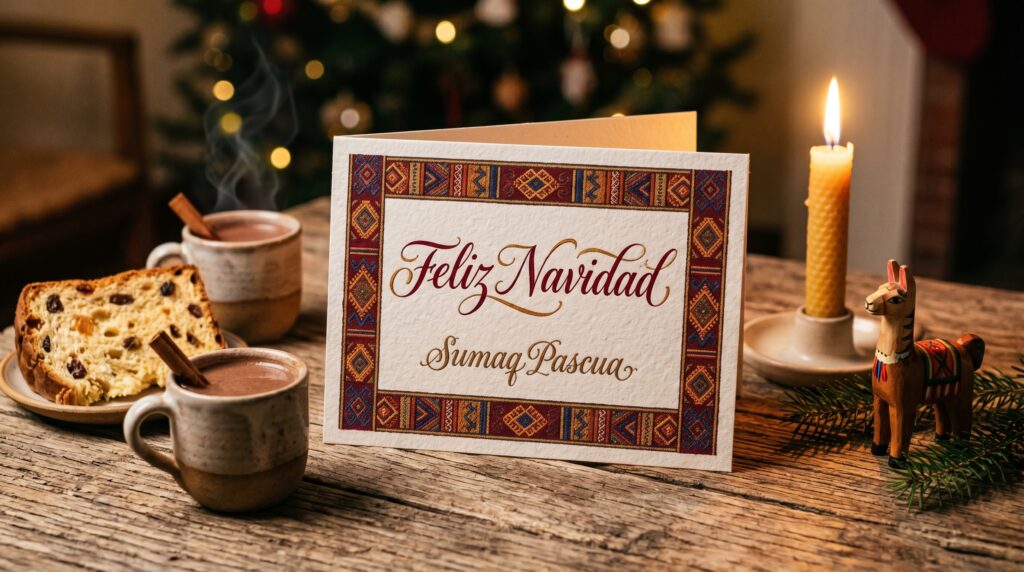
A nice move: use both in the same card. Open with “Feliz Navidad” and add “Sumaq Pascua” below it (just like our hero image on this post). It covers both bases and shows extra care.
Use “Suma Phaxsi Marani” if:
- The person is specifically from the Aymara-speaking regions (around Lake Titicaca, in the Puno highlands)
- You know they identify as Aymara
- You want a really distinctive greeting that most non-Aymara people won’t recognize
Example greetings for Christmas cards
Casual / friend
“Feliz Navidad! Hope your holidays are full of family, panetón, and hot chocolate.”
Formal / professional
“Wishing you a Feliz Navidad and a Próspero Año Nuevo. May the new year bring you health, prosperity, and happiness.”
Andean-respectful / family from Cusco region
“Sumaq Pascua! Feliz Navidad! Sending love from across the miles. May the new year bring good things to you and your family.”
Short and warm
“Feliz Navidad y Sumaq Pascua. With love.”
Merry Christmas in Peru FAQ
How do you say Merry Christmas in Peruvian?
“Peruvian” isn’t one language. Peru has three main languages: Spanish, Quechua, and Aymara. In Spanish: “Feliz Navidad.” In Quechua: “Sumaq Pascua” or “Allin Pascuata.” In Aymara: “Suma Phaxsi Marani.”
What language do Peruvians speak at Christmas?
Most Peruvians speak Spanish, so most Christmas greetings happen in Spanish. But in the Andean highlands (Cusco, Puno, Ayacucho), millions of Peruvians speak Quechua, and Christmas greetings, prayers, and even Catholic masses in those regions often include Quechua. Aymara is spoken around Lake Titicaca.
How do you say Feliz Navidad in Quechua?
The most common Quechua Christmas greeting is “Sumaq Pascua” (Beautiful Christmas) or “Allin Pascuata” (Good Christmas). Both mean roughly the same thing and are used interchangeably.
Is Quechua still spoken in Peru?
Yes, very much. Quechua is spoken by about 4 to 5 million people in Peru, mostly in the Andean highlands. It’s an official language of Peru alongside Spanish and Aymara. Many Peruvian families are bilingual, and the language is actively taught in schools in many highland regions.
How do you pronounce Sumaq Pascua?
Roughly SOO-mahk PAHS-kwah. The “q” in “Sumaq” is a guttural sound from the back of the throat (like a soft throat-clear). If you can’t do that sound, a soft “k” is close enough and Quechua speakers will understand you.
What’s the difference between Quechua and Aymara?
They’re two completely separate indigenous languages. Quechua was the language of the Inca empire and is spoken widely across the Andes (Peru, Ecuador, Bolivia, parts of Colombia, Argentina, Chile). Aymara is older than Quechua in some regions and is spoken mainly around Lake Titicaca on the Peru-Bolivia border. They sound different, have different grammar, and use different vocabulary.
That’s it
Now you can write that Christmas card with confidence. “Feliz Navidad” works for almost everyone. Add “Sumaq Pascua” if the person is from the Andean highlands and you want to go the extra mile.
For more on Peruvian Christmas culture (food, traditions, music, decorations), read our complete guide to Peruvian Christmas. And if you’re putting together a Peruvian Christmas gift to go with that card, browse our Christmas Gifts collection.
Feliz Navidad. Sumaq Pascua. Suma Phaxsi Marani.