By Paul G.
Some cultures have a Christmas meal. Peruvians have an event.
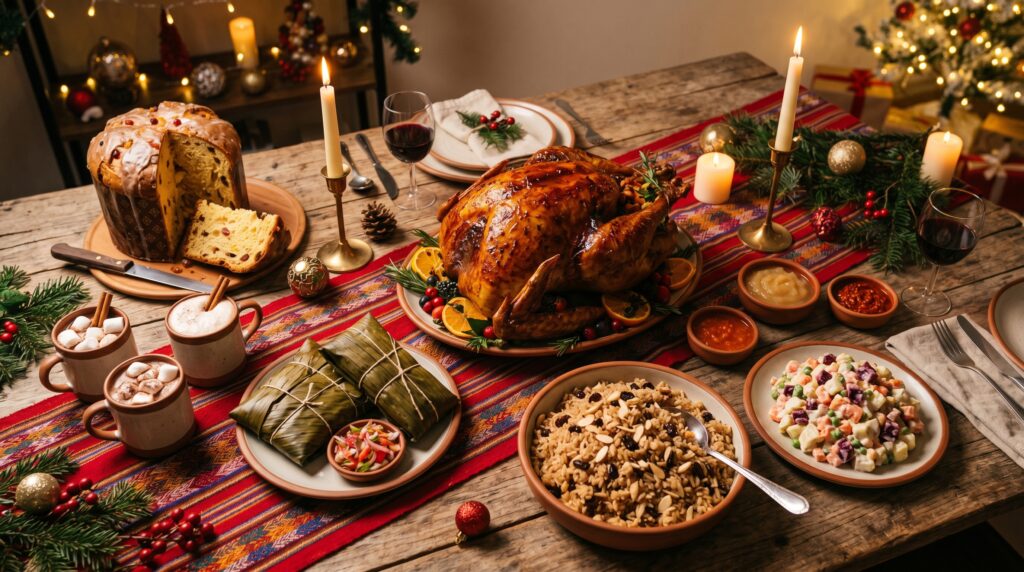
It starts late, runs past midnight, takes the whole family to put together, and combines flavors you don’t see anywhere else. Italian sweet bread next to Andean rice. Russian potato salad next to Spanish-influenced roast turkey. Hot chocolate so thick you eat it with a spoon. The food on a Peruvian Christmas Eve table is the result of 500 years of cultural mixing, and most of it tastes incredible.
Here’s everything that shows up on a Peruvian Christmas table, where it came from, and how you can put a version of it together yourself if you want to.
How the Peruvian Christmas Eve dinner actually works
Before the food itself, the structure: in Peru, Christmas Eve dinner is the main event of the holiday season. Not Christmas Day. December 24 is when families gather, the kitchen is busy all day, and dinner doesn’t start until 10 or 11 PM.
The night goes like this. Family arrives in the evening, mostly to help cook or hang out. Around 10 PM, people start sitting down. Tamales come out as a starter. Then the main turkey and the sides. People eat slowly. They drink (wine, pisco sour, beer). They talk.
Right before midnight, the table gets reset for dessert. Panetón comes out. Hot chocolate is poured. At midnight, fireworks go off across the country, everyone hugs, the kids open gifts, and then the family stays at the table eating sweet bread and drinking hot chocolate until 2 or 3 in the morning. December 25 is mostly a recovery day.
Full context on the rest of the night is in our post on Peruvian Christmas traditions.
The main dishes
Pavo navideño (Peruvian Christmas turkey)
Pavo navideño is the centerpiece. A whole roasted turkey, usually 12-18 pounds, marinated and seasoned in distinctly Peruvian ways.
The marinade is what makes it different. Aji panca (a smoky red Peruvian pepper paste) is the foundation. Then garlic, a lot of it. Soy sauce (a Chinese influence that became fully Peruvian). Sometimes oregano, pepper, and a bit of beer or pisco. Most families marinate the turkey for 24 to 48 hours before cooking it. The whole house smells like garlic and aji for two days. That smell is the smell of Peruvian Christmas.
It’s roasted in the oven low and slow, basted regularly. Served with the side dishes (see below). Carved at the table by whoever’s the designated patriarch or matriarch.
Some families do chicken or pork instead of turkey, especially in regions where good turkey is harder to find. But turkey is the classic.
Tamales criollos
Most coastal Peruvian households also have tamales on the Christmas Eve table, usually as a starter before the turkey. Peruvian tamales are heavier and more savory than Mexican ones. They’re made from corn or rice masa, stuffed with pork or chicken, sometimes with a hard-boiled egg or olive inside, wrapped in plantain leaves, and steamed.
These take serious work to make. Many families make a huge batch on December 23 and serve them on the 24th. They’re rich, filling, and they pair really well with the lighter dishes that come later. Often served with a side of salsa criolla (red onion and lime mix).
The sides that pair with the turkey
Arroz arabe (Arabic rice)
Don’t let the name confuse you, this is fully Peruvian now. Arroz arabe is rice mixed with browned noodles (broken fideos), raisins, and toasted almonds. The noodles get cooked in butter or oil until they’re golden brown, then mixed with rice. The result is sweet, nutty, slightly chewy, and it’s everywhere on a Peruvian Christmas table.
The name comes from Middle Eastern immigrants who brought the technique. Peruvian families adopted it, added their own twists, and now it’s a Christmas staple. If you make it once, it’s not hard to make. And it’s the dish your guests will ask about because they’ve never had it before.
Apple sauce or fruit-based side
Peruvian Christmas turkey usually gets served with a sweet fruit-based side. Apple sauce is common. So is a chunky apple-and-fruit stew called compota de manzana. Some families do a fruit chutney with apples, pears, and dried fruit. The combination of savory turkey + slightly sweet fruit is classic.
Ensalada rusa (Russian potato salad)
Another one that ended up in Peruvian Christmas via immigration. Ensalada rusa is a cold potato salad with peas, carrots, and mayonnaise. Sometimes hard-boiled eggs, sometimes a little ham, sometimes pickles. It’s lighter than the heavier dishes, it pairs with everything, and it’s everywhere in Lima especially.
Other things you might see
- Pavo asado leftovers sliced cold the next day with bread
- Pasta or rice as additional starch on the side
- Bread, sometimes with garlic butter or just plain
- Olives, cheese, cold cuts as appetizers earlier in the night
Want a piece of Peru on your table this year?
If you’re putting together a Peruvian Christmas dinner and you want a centerpiece or table decoration that fits the theme, our Christmas Gifts collection has hand-carved pieces from Cusco artisans. Machu Picchu sculptures, leather goods, bull horn pieces. Made by hand in Peru.
Panetón + hot chocolate: the part everyone waits for
If there’s one moment that defines Peruvian Christmas, this is it. Around 11:30 PM, the table gets reset. The plates from the main meal are cleared. Out comes the panetón and the chocolatada (hot chocolate). It’s the dessert, but it’s also the ritual. Every Peruvian household does this.
Panetón (Peruvian panettone)
Panetón is the iconic Peruvian Christmas bread. A tall, domed sweet bread filled with candied fruits and raisins, often a little citrus zest, with a soft fluffy crumb. It’s descended from the Italian panettone that Italian immigrants brought to Peru in the late 19th and early 20th centuries. Today it’s fully Peruvian and the brands that sell it (D’Onofrio especially) move millions of these every year.
Famous brands you’ll see in Peru and increasingly in US Latin grocery stores:
- D’Onofrio — the most iconic, the default brand most families buy
- Gloria — the other big one, comes in a tall yellow box
- Todinno — bakery-style, a bit fancier
- Motta — Italian-origin, available in some markets
- Bauducco — Brazilian but widely sold in Peru and the US
Most families have at least one panetón sitting on the kitchen counter throughout December. On Christmas Eve, you cut thick slices and eat them with hot chocolate. That’s the move.
Chocolatada (Peruvian hot chocolate)
Peruvian Christmas hot chocolate is not the cocoa-powder-and-water version. It’s made from real cocoa, hot milk, cinnamon sticks, sometimes a few cloves, and often a little evaporated milk to thicken it. Some families add a bit of cocoa butter or a small piece of dark chocolate to make it extra rich.
It’s served warm, in small mugs, alongside the panetón. The combination of the spiced hot chocolate and the sweet bread is the taste of Peruvian Christmas. If you do nothing else from this whole list, do this one.
Desserts beyond panetón
Panetón is the main dessert moment, but Peruvian Christmas tables also include other sweet things, especially in households with a strong baking tradition.
- Suspiro a la limeña — a Lima specialty: thick caramel-like cream (manjar blanco) topped with port wine meringue. Sweet, rich, served in small cups.
- Manjar blanco-filled pastries — small cookies or puff pastries filled with the same caramel cream
- Turrón de Doña Pepa — a layered sweet bread with anise syrup and colorful sprinkles. Originally an October dessert (for the Lord of Miracles festival) but often appears at Christmas too
- Imported Christmas chocolates — boxes of nice chocolates from Lindt, Ferrero, or local Peruvian chocolatiers
- Fresh fruit — December is summer in Peru, so fresh fruit (mango, pineapple, papaya, watermelon) often makes it onto the dessert table
The 12 grapes at midnight (technically a New Year’s tradition that bleeds into Christmas)
This one is actually a New Year’s Eve tradition more than a Christmas Eve one, but the two nights run on similar structures and you’ll see it on Christmas Eve in some Peruvian households too. At the stroke of midnight, you eat 12 grapes, one for each month of the coming year. Each grape is a wish. Some families also wear yellow underwear for good luck (yes, really).
It comes from Spain originally and is more associated with December 31. But Peruvian households sometimes do it on Christmas Eve as well, especially if there’s a count to midnight happening.
Regional differences in Peruvian Christmas food
Peruvian Christmas food varies a lot by region.
Coastal Christmas food (Lima, the coast)
On the coast, the food leans more Italian and European-influenced. Heavy emphasis on panetón. Lots of pasta dishes alongside the main turkey. Ensalada rusa is more common. Seafood appetizers in some households (especially in Lima).
Andean Christmas food (Cusco, Puno, the highlands)
In the Andes, the food is heartier and incorporates more indigenous ingredients. Quinoa often shows up in side dishes. Stews with cuy (guinea pig) or alpaca meat are more common, especially in rural communities. The hot chocolate is more often spiced with local highland ingredients. Roasted potatoes (Peru has hundreds of native potato varieties) are central.
Amazonian Christmas food (Iquitos, Pucallpa, the jungle)
In the jungle, the menu shifts toward river fish, tropical fruits, and dishes specific to the Amazon. Roasted river fish (paiche, doncella) sometimes replaces or accompanies turkey. Yuca and plantains are big. Tropical fruit desserts dominate. The vibe is hot and humid in December, so the lighter ingredients make sense.
How to put together a Peruvian Christmas meal at home
If you want to do a Peruvian Christmas dinner for your own family this year, you don’t have to do the whole thing. Just doing two or three of the staples gets you most of the way there. Here’s the easiest path:
The minimum: hot chocolate + panetón
This is the entry-level Peruvian Christmas experience and you can do it in 30 minutes. Buy a panetón at any Latin grocery store (D’Onofrio if they have it). Make hot chocolate from scratch: 1 cup whole milk, 2 tablespoons real cocoa powder, 1 cinnamon stick, a small piece of dark chocolate, a pinch of sugar. Warm slowly. Serve hot, with thick slices of panetón.
Do this on Christmas Eve at 11 PM. You’ll get it.
The next step: add the turkey
Marinate a turkey in a blend of aji panca paste (or chipotle as substitute), a lot of garlic (10-15 cloves crushed), soy sauce, a bit of olive oil, salt, and pepper. Massage it into the bird, cover, refrigerate overnight. Roast it the next day at 325°F until it hits 165°F internal temperature in the thickest part of the thigh. Baste every 30 minutes. Aji panca paste is available online and in some specialty grocery stores.
Going all-in: full Peruvian table
If you want the full experience, add:
- Tamales (buy them from a Peruvian or Latin restaurant if you don’t have time to make them, the process is intense)
- Arroz arabe (rice + browned noodles + raisins + almonds, easy to make)
- Ensalada rusa (potato salad with peas, carrots, mayo, easy)
- Apple sauce or compota de manzana on the side
- Suspiro a la limeña or manjar blanco pastries for additional dessert
Start cooking the day before. Marinate the turkey overnight. Save the panetón and hot chocolate for the actual midnight moment. Eat slowly. Stay up late.
Where to find Peruvian Christmas ingredients in the US
Most of the specialty ingredients are findable if you look:
- Panetón — D’Onofrio, Gloria, and other brands are sold at most Latin grocery stores in cities with Peruvian populations (Miami, NJ, NY, Chicago, LA, the DC area, parts of Texas). Also available on Amazon, often in November and December
- Aji panca paste — Available on Amazon, at Latin specialty stores, and in some larger Hispanic grocery chains
- Quinoa and tropical fruit — Easy at any grocery store
- Real Peruvian chocolate — Specialty Latin stores or online retailers that import Peruvian goods
- Aji amarillo paste (for the marinade) — Same sources as aji panca
If you can’t find specific ingredients, substitutes work. Chipotle paste for aji panca. Any good panettone (Bauducco, even Italian brands) for panetón. Real cocoa powder + cinnamon for the hot chocolate. The spirit of the meal is more important than perfect authenticity.
Peruvian Christmas Food FAQ
What’s the main dish of a Peruvian Christmas dinner?
Pavo navideño (Peruvian Christmas turkey) is the centerpiece. A whole roasted turkey marinated with aji panca paste, garlic, soy sauce, and other Peruvian seasonings for 1-2 days before cooking. Served with sides like arroz arabe, apple sauce, and ensalada rusa.
What’s panetón and why do Peruvians eat it at Christmas?
Panetón is the Peruvian version of Italian panettone — a tall, domed sweet bread filled with candied fruits and raisins. Italian immigrants brought it to Peru in the late 1800s and it became a Christmas staple. Most Peruvian families eat it on Christmas Eve, in thick slices, alongside hot chocolate.
What time do Peruvians eat Christmas dinner?
Late. Most families sit down between 10 and 11 PM on December 24. The main meal stretches across the night. At midnight, fireworks go off across Peru, then everyone returns to the table for panetón and hot chocolate. The meal often continues until 2 or 3 AM.
What’s the most iconic Peruvian Christmas food?
The combination of panetón and hot chocolate eaten at midnight on Christmas Eve is the most universally iconic moment of Peruvian Christmas food. Almost every Peruvian household, in every region and every income bracket, does this.
Can I make Peruvian Christmas food in the US?
Yes. The main specialty ingredients (panetón, aji panca paste) are widely available at Latin grocery stores and on Amazon, especially in November and December. Most recipes scale easily for any size family. If you can only do one thing, make real hot chocolate with cinnamon and pair it with panetón at midnight. That’s the most universally meaningful piece.
What’s arroz arabe?
Arroz arabe is a Peruvian Christmas rice dish made with rice, browned noodles, raisins, and toasted almonds. Despite the name (“Arabic rice”), it’s a Peruvian creation that emerged from Middle Eastern immigrant influence. Sweet, nutty, and unique to Peruvian Christmas tables.
Do Peruvians drink wine on Christmas Eve?
Yes, wine is common during the main meal. Pisco sour (the Peruvian national cocktail) is also popular at the start of the evening. Beer is widely consumed too. Then everyone switches to hot chocolate around midnight for the dessert moment.
Bring some of it to your own table this year
You don’t have to do the whole thing to bring a piece of Peruvian Christmas into your own holiday. Make hot chocolate from scratch on Christmas Eve. Buy a panetón. Cut thick slices. Drink slowly. Stay up late.
Want the rest of the picture? Read our complete guide to Peruvian Christmas for the traditions, decorations, music, and everything else. And for handmade Peruvian Christmas gifts (the kind that ship from Cusco), browse our Christmas Gifts collection.
Feliz Navidad. Provecho.