By Paul G.
Peruvian Christmas decorations are different. Not in a small way. In a way you notice the second you walk into a Peruvian household in December.
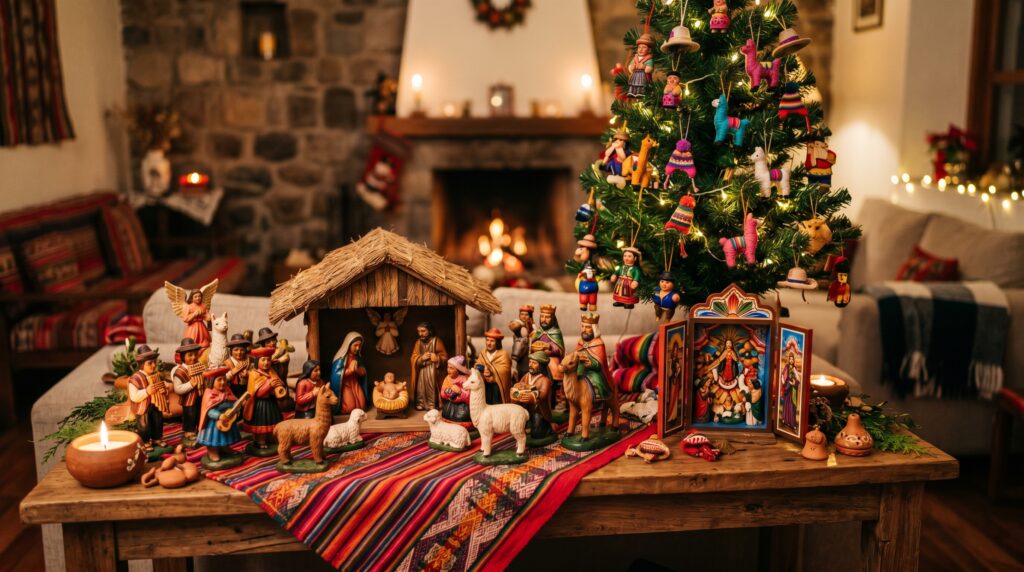
There’s a nativity scene that has llamas in it. The Christmas tree is decorated with little wooden ornaments hand-painted by someone in Cusco. There’s a small wooden box on the table that opens up into a religious scene. Hand-woven textile runs across the table instead of a printed runner. The baby Jesus in the nativity wears a tiny chullo hat.
If you want some of that in your own home, here’s the full breakdown. What real Peruvian Christmas decorations look like, where they come from, how to spot the authentic ones, and where to get them.
What makes Peruvian Christmas decorations different
Two big things. First, almost everything is handmade. Not factory-printed, not mass-stamped, not plastic. Real wood, real ceramic, real fabric, all shaped by hand by an artisan in the Andean highlands. Most of these crafts have been passed down for generations.
Second, the imagery is Andean, not European. The nativity scene has llamas instead of donkeys. The baby Jesus wears a chullo. The shepherds are dressed like Quechua villagers. The Wise Men are sometimes shown carrying Andean instruments. So even though the underlying scene is Catholic, the look and feel is Peruvian through and through.
You can read more about how this cultural blending happened in our post on Peruvian Christmas traditions. The short version: Spanish missionaries brought the religious imagery in the 1500s. Indigenous artisans started making it with local materials and aesthetics. It never went back to looking European.
Nacimientos: the centerpiece of Peruvian Christmas
The nacimiento (nativity scene) is the most important Christmas decoration in a Peruvian household. More important than the Christmas tree. Most families set it up the first weekend of December.
A real Peruvian nacimiento isn’t 5 figures. It’s 20, 30, sometimes 50. The Holy Family in the manger, the three Wise Men, shepherds, llamas, alpacas, indigenous musicians, villagers in traditional Andean clothing. The whole village comes to see the baby. Some families build their nacimiento across a whole side table. Others use an entire corner of the living room.
The figures are usually hand-carved or molded ceramic. Sometimes painted, sometimes left in natural wood or clay. The really good ones come from Cusco or Ayacucho, and they last for generations. Most families add a few new figures every year. By the time you’ve been doing this for 20 years, your nacimiento is enormous.
And here’s the tradition that surprises a lot of foreigners: the baby Jesus figure doesn’t go in the manger until midnight on December 24. The manger stays empty all of December. He shows up at midnight. In some families, the youngest kid carries the baby Jesus figure over to the manger. That’s also when the gifts come out and the fireworks start.
What to look for in a real nacimiento set
- Hand-carved or molded ceramic figures (not painted plastic)
- Andean clothing on the villagers (chullos, ponchos, traditional skirts)
- Llamas and alpacas alongside the Holy Family
- Slight variations between figures (handmade = imperfect)
- Made in Cusco, Ayacucho, or other traditional artisan regions
Retablos: the small wooden boxes from Ayacucho
A retablo is a small wooden box that opens up. Inside is a complete religious scene built from molded ceramic figures, hand-painted by the artisan. The Holy Family. Saints. Sometimes a whole village. The box itself is painted on the inside doors with bright traditional colors.
Retablos are the signature folk craft of Ayacucho, a region in the south-central Andes. The most famous artisan families there have been making retablos for centuries. A good handmade retablo can take a master craftsperson weeks. They’re small, portable (you can close the doors), and they’re some of the most authentic pieces of Peruvian Christmas folk art you can own.
Sizes range from pocket-sized (about 4 inches tall) to large floor pieces (over 2 feet). Pocket-sized retablos are some of the most popular gifts to bring back from a Peru trip. Larger ones become permanent home decorations.
How to tell a good retablo from a tourist-trap one
- The box should be solid wood, not pressed cardboard
- The figures inside should be molded ceramic with visible hand-painting (not printed)
- The interior doors should be hand-painted with detail
- Made in Ayacucho specifically (it’s the regional craft)
- Heavier than it looks. A good retablo has weight to it
Hand-carved wooden Christmas ornaments
These are the smaller pieces that hang on the Christmas tree or sit on shelves around the house. Hand-carved from wood by Peruvian artisans, then painted in bright traditional colors. Common shapes:
- Llamas wearing tiny embroidered blankets
- Andean villagers in traditional dress
- Tiny chullos (the Peruvian knit hat)
- Musicians playing zampoñas or charangos
- Stars and angels with Andean styling
- Tiny manger scenes
These are affordable, they travel well (lightweight, durable), and they make really good gifts. They’re also the easiest way to add a Peruvian touch to your existing Christmas decorations without committing to a full nacimiento. You can put a few on your tree and the look completely changes.
In Peru, you’ll find these all over the Cusco Christmas markets, especially at Santurantikuy on December 24. That’s the big artisan market in the Cusco main plaza where you can buy every kind of handmade Christmas decoration in one place.
Want handmade Peruvian crafts for gifts (not just decorations)?
Our Christmas Gifts collection brings together our handmade Peruvian pieces. Hand-carved leather goods, bull horn flasks and pipes, Machu Picchu sculptures. Some work as decorations, all work as gifts.
Specifically for nacimientos and tree ornaments, we don’t make those ourselves yet (we partner with Cusco artisan families who specialize in different crafts). But pieces from us pair well with traditional Peruvian decorations for a complete Andean Christmas look.
The Christmas tree in Peru
Yes, Peruvians have Christmas trees. They came to Peru with European immigrants in the late 1800s and now most households have one.
The tree itself is usually artificial, because real evergreens are rare in most of Peru. The decorations are a mix: imported store-bought ornaments alongside handmade Peruvian pieces. Most families set up the tree the first week of December, decorate it with the kids, and put the nacimiento at the base.
If you want to give your tree a Peruvian feel, the easiest way is to add hand-carved wooden ornaments. Even a few of them changes the whole look. You can mix them with classic ornaments and the tree feels distinctly Andean without being over-the-top themed.
Andean textiles: table runners and accents
One of the simplest ways to bring Peruvian style into your Christmas setup is with handwoven Andean textiles. Table runners, throw pillows, woven blankets, smaller mats. The colors are deep reds, ochres, blues, and greens. The patterns are geometric and ancient. Each weaving region in Peru has its own distinct style.
A handwoven textile runner across your Christmas table makes the whole setup feel different. Same with throw pillows in Andean patterns scattered on a couch. These pieces are also genuinely useful year-round, so the investment makes sense even outside of Christmas.
Look for pieces that say handwoven in Peru with specific regional names (Chinchero, Pisac, Cusco, Puno). Mass-produced “Peruvian-style” textiles printed in factories are everywhere. The real ones have weight, slight irregularities in the weave, and colors that come from natural dyes.
Niño Manuelito: the Peruvian baby Jesus
Niño Manuelito is the Peruvian version of the baby Jesus figure. He’s often dressed in traditional Andean clothing. A tiny chullo. A small poncho. Sometimes a sash.
In Peruvian families, the Niño Manuelito figure is usually kept separately from the rest of the nacimiento and placed in the manger only at midnight on December 24. Some families have a Niño Manuelito that’s been passed down for generations. Others swap his outfit a few times during the Christmas season for different feast days. Christmas Eve outfit, New Year outfit, Epiphany outfit.
If you visit Cusco’s Santurantikuy market on December 24, you’ll see entire stalls selling tiny handmade outfits specifically for Niño Manuelito figures. It’s a craft tradition within the larger one.
Where to find authentic Peruvian Christmas decorations (and how to spot the fakes)
This is the practical part. If you want real Peruvian Christmas decorations and not factory-made imitations, here’s how to find them.
If you can travel to Peru
Go to Cusco in mid-to-late December. The Santurantikuy market in the central plaza on December 24 is the most concentrated source of authentic handmade Peruvian Christmas decorations in the world. Artisans come from across the southern Andes specifically to sell during this market.
Outside of December, the regular Cusco markets (San Pedro, San Blas) and Pisac’s Sunday market are good places to find handmade pieces year-round. Smaller artisan towns like Chinchero (textiles) and Quinua, near Ayacucho (retablos) are even better if you have time.
If you’re buying online
Look for sellers who actually work with Peruvian artisan workshops directly. Watch out for:
- Listings that say “Peruvian style” but don’t say “made in Peru” (usually mass-produced)
- Identical photos across multiple sellers (means it’s a factory product)
- Perfect uniformity between pieces (real handmade has slight variations)
- Suspiciously low prices for what should take days of handmade work
Look for:
- “Handmade in Cusco” or “Handmade in Ayacucho” in the listing
- Photos that show slight variations between pieces
- Stories about the artisan family or workshop
- Higher prices that reflect the actual labor of handmade work
Peruvian Christmas Decorations FAQ
What’s the most important Peruvian Christmas decoration?
The nacimiento (nativity scene) is the centerpiece in every Peruvian household. More important than the Christmas tree. Most families build their nacimiento over years, adding new figures each season.
Are Peruvian Christmas decorations religious?
Many are, because Peru is predominantly Catholic and the centerpiece decorations (nacimientos, retablos, Niño Manuelito) are religious. But the imagery is heavily blended with Andean culture (llamas, traditional clothing, indigenous musicians), and there’s also plenty of non-religious decoration like hand-carved ornaments, textile runners, and tree decorations.
Where do the best Peruvian Christmas decorations come from?
Cusco (for general nativity figures, ornaments, and textiles), Ayacucho (for retablos), and the smaller artisan towns around the Sacred Valley like Pisac and Chinchero (for handwoven textiles).
What’s Santurantikuy?
Santurantikuy is the biggest Peruvian Christmas artisan market, held in Cusco’s central plaza on December 24. The name means “buying of saints” in Quechua. Artisans from across the southern Andes come to sell handmade nativity figures, retablos, ornaments, and decorations. If you want to see the most concentrated source of authentic Peruvian Christmas decorations in one place, this is it.
Can I get authentic Peruvian Christmas decorations without going to Peru?
Yes, but you have to be careful. Many online listings say “Peruvian” but are mass-produced in factories. Look for sellers who specifically say handmade in Peru, ideally name the region (Cusco, Ayacucho), and show photos with slight variations between pieces. Higher prices usually reflect real handmade work.
What’s a retablo?
A retablo is a small wooden box that opens up to reveal a religious scene built from molded ceramic figures, hand-painted by the artisan. Retablos are the signature folk craft of the Ayacucho region of Peru. They’re some of the most authentic and culturally rich Peruvian Christmas decorations you can own.
Bringing a piece of Peru into your Christmas
Whether you’re going all-in on a full Peruvian Christmas with a real nacimiento and a retablo on the side table, or you just want a couple of hand-carved wooden ornaments on your existing tree, the pieces themselves carry the culture. They were made by real people whose families have been doing this work for generations.
If you want to go further than decorations and give a Peruvian gift, our Christmas Gifts collection has the pieces we make ourselves. Hand-carved leather goods. Bull horn pipes and flasks. Machu Picchu sculptures. Made by hand by artisans in Cusco. All ship worldwide.
Want the full picture of how Peruvian Christmas actually works (food, music, traditions, everything)? Read our complete guide to Peruvian Christmas.
Feliz Navidad from Crafted In Peru.