By Paul G.
Look, every culture has Christmas traditions. But if you’ve never seen a Peruvian one, some of them are gonna surprise you. We do dinner at midnight, not 6 PM. We open gifts on Christmas Eve, not Christmas morning. Our nativity scenes have llamas in them. And the whole thing stretches from early December until February.
I grew up with these traditions. Here’s the full breakdown of how Christmas actually works in Peru, what you’ll see if you go, and what we still do as a family even living here in the States.
First, the Christmas season in Peru is long
In the States, Christmas pretty much starts the day after Thanksgiving and ends January 1. That’s it. Five weeks, give or take.
In Peru, the Christmas season is more than two months. Decorations start going up December 1. The nacimiento (the family nativity scene) gets built up over the first week of December. And nothing comes down until February 2, which is the Catholic feast day of the Presentation. So the season is December 1 to February 2.
In between, you’ve got Christmas Eve on December 24, New Year’s Eve on December 31, then Epiphany on January 6 (we call it Bajada de los Reyes, “coming down of the Kings,” when families give a small gift to a friend’s child). Then the season closes on February 2. It’s a whole vibe that runs all summer.
Pre-Christmas: building the nacimiento
The first big tradition of the Peruvian Christmas season is building the nacimiento. The nativity scene. This is more important than the Christmas tree.
Families usually set up the nacimiento on the first weekend of December. It’s a big project. Some households have a small one. Others spread the scene across a whole table or even a corner of the living room. The figures, mostly hand-carved or molded ceramic, often come from places like Ayacucho or the markets of Cusco. Many families add a few new pieces every year. By the time you’ve been doing this for 20 years as a couple, your nacimiento might have 40 or 50 figures.
And here’s a tradition that surprises a lot of foreigners: the baby Jesus figure doesn’t go in the manger until midnight on December 24. The manger stays empty all of December. He shows up at midnight when everyone toasts. It’s a small ritual, but it’s a real one. In some families, the youngest kid carries the baby Jesus figure over to the manger.
The Novena
Some Peruvian families do the Novena, nine days of evening prayers leading up to Christmas Eve. It runs from December 16 to December 24. Each night the family gathers around the nacimiento, sings a villancico (Peruvian Christmas carol), reads a short prayer, and eats something small. The kids usually get a tiny treat at the end.
Not every family does the Novena anymore. It’s more common in the Andean highlands and in older Catholic households. But if you visit Peru in mid-December, you’ll hear villancicos coming from open windows in the evenings, and that’s the Novena happening.
Misa de Gallo (the midnight mass)
The night of December 24 traditionally starts with Misa de Gallo. The midnight mass. The name literally means “rooster’s mass” because of an old story that a rooster crowed when Jesus was born.
Misa de Gallo is one of the most attended church services of the entire year in Peru. Big cities like Lima and Cusco fill their churches to capacity. Smaller towns might have a single Mass at midnight that the whole community attends. Some families go to mass right before midnight, others go right after. Either way, it’s an important moment.
If you’re not Catholic, this part doesn’t have to be your thing. Plenty of modern Peruvian families skip Mass and just gather at home. But the cultural weight of Misa de Gallo is still part of how the night is structured.
La Cena de Nochebuena (Christmas Eve dinner)
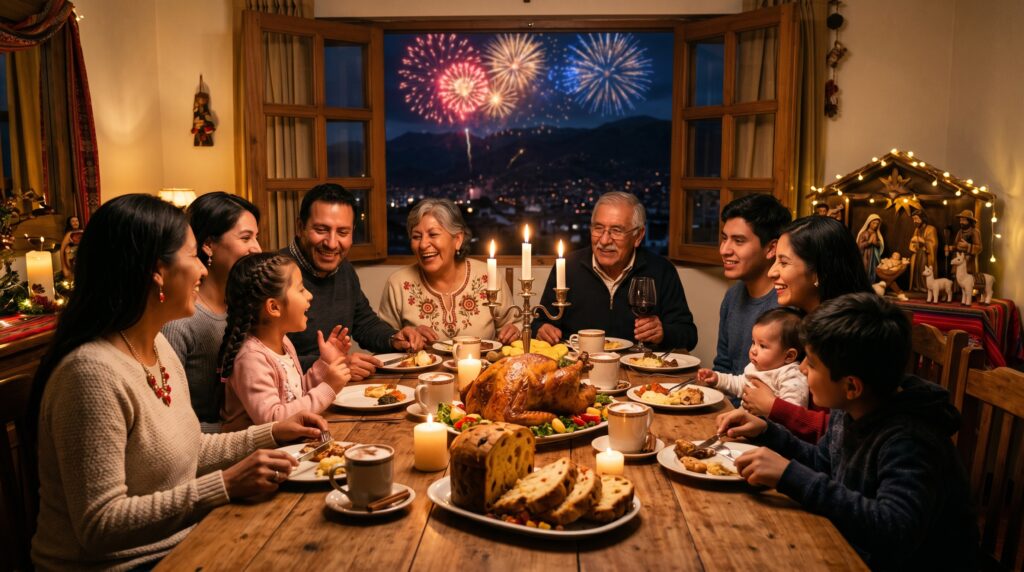
The Christmas Eve dinner is the heart of Peruvian Christmas. We call it la cena de Nochebuena, the “Good Night dinner.” And here’s the thing: it doesn’t start at 6 PM. It starts late.
Most families sit down between 10 and 11 PM. Sometimes later. The cooking has been happening all day. Some dishes were prepared the day before. The whole house has been smelling like roasting turkey for hours. The kids have been waiting impatiently.
Dinner stretches across the night. People eat. They toast. They talk. Then more food comes out. Then the panetón. Then the hot chocolate. By the time you look at your watch, it’s 2 AM and nobody’s tired.
I wrote a whole section on the food in our pillar guide: what shows up on a Peruvian Christmas table.
Midnight: the fireworks moment
At exactly 12 AM on December 25, fireworks go off across every city and town in Peru. From Lima on the coast to the Andean highland towns to the Amazon cities, the sky lights up. Every neighborhood. It’s loud, it’s bright, and it’s one of the most distinctly Peruvian sounds of Christmas.
This is the moment families step outside, hug each other, and watch. Kids run out to see the fireworks. In some towns, the whole community spills into the street. It’s not a formal event, it’s a spontaneous one that happens every year because that’s just what we do.
Then back inside. The toasts continue. The baby Jesus goes into the manger. The kids get to open gifts. Everyone says “Feliz Navidad” to everyone else in the room.
Gift exchange happens at midnight, not in the morning
This is one of the biggest cultural differences from how Christmas works in the States. In Peru, the gift exchange happens at midnight on December 24, right after the fireworks. Not on Christmas morning.
So as a kid in Peru, you don’t go to bed and then wake up to find presents under the tree. You stay up. You wait. You eat dinner. Right when the clock hits 12 AM and the fireworks start, that’s when you get to run to the tree.
The gifts are usually under the tree, but they appear at the foot of the nacimiento too. The baby Jesus brings them, technically. Younger kids in some households are told that El Niño Jesús (the baby Jesus) brings the gifts, not Santa. Santa exists in Peru, but he’s a softer presence than in the US. The main gift-giver is the baby Jesus.
Gift-giving piece with a story behind it?
If you’re putting together holiday gifts and you want something handmade with a real Peruvian story, our Christmas Gifts collection has the pieces that work. Hand-carved leather, Machu Picchu sculptures, bull horn crafts, all made by hand by artisans in Cusco.
Niño Manuelito and his many outfits
I mentioned Niño Manuelito in the pillar. He’s the specifically Peruvian version of the baby Jesus figure. Often dressed in a tiny chullo hat or a small poncho. Some families have a Niño Manuelito that’s been passed down for generations.
Here’s the tradition that surprises people: some Peruvian families change Niño Manuelito’s outfit throughout the Christmas season. Different clothes for different feast days. A Christmas Eve outfit. A New Year outfit. An Epiphany outfit. By February 2, he might have worn five different little outfits.
If you visit the Cusco Christmas market (Santurantikuy) on December 24, you’ll see artisans selling tiny handmade outfits specifically for Niño Manuelito figures. Tiny embroidered ponchos. Tiny knit hats. It’s a small craft tradition within the larger one.
December 25: the slow day
After staying up until 2 or 3 AM eating, drinking, and watching fireworks, Christmas morning in Peru is quiet. People sleep in. Around lunch, families pull out the leftover turkey and panetón. There’s a long lazy afternoon. Sometimes a visit to extended family. Sometimes just a nap.
December 25 is not the main event in Peru. It’s the day after the main event. It’s relaxed, slow, and meant for recovery.
New Year and Bajada de los Reyes
Once Christmas Eve is past, the season keeps going. New Year’s Eve (December 31) is another big night, structured similarly. Late dinner. Fireworks at midnight. Family. New Year traditions in Peru also include eating 12 grapes at midnight (one for each month) and wearing yellow underwear (yeah, really, it’s for luck).
Then on January 6, there’s Bajada de los Reyes, “the coming down of the Kings.” This is Epiphany, the day the three Wise Men supposedly arrived to see baby Jesus. In Peru, families add the three Wise Men figures to the nacimiento that day. Some families also give a small gift to a friend’s child or to a godchild on Bajada de los Reyes. It’s not as big as Christmas Eve, but it’s still part of the season.
The season officially closes on February 2, the feast day of the Presentation of Jesus at the Temple. That’s when the nacimiento finally gets put away until next December.
Regional differences: coast, mountains, jungle
Peru has three really different regions: the coast (where Lima is), the Andean mountains, and the Amazon jungle. Christmas traditions vary by region.
Coastal Christmas
On the coast, Christmas is more European-style than in the highlands. Lima and the beach towns lean toward Italian-inspired food (panetón is huge, lots of pasta side dishes), and the Catholic traditions are more prominent. Beach trips are common in the days leading up to Christmas because the weather is great.
Andean Christmas
In the Andes, around Cusco, Puno, Ayacucho, and the highland towns, the indigenous Quechua and Aymara cultures show through more strongly. Villancicos are sung in Quechua. Nativity scenes include llamas and alpacas. The Niño Manuelito wears traditional Andean clothing. The Cusco Christmas market (Santurantikuy) on December 24 is the most concentrated version of this. If you ever want to experience the most authentic Peruvian Christmas, go to Cusco.
Amazonian Christmas
In the jungle cities like Iquitos and Pucallpa, Christmas has its own flavor. The food includes more tropical fruits, river fish, and dishes specific to the Amazon. Indigenous communities often blend Catholic traditions with their own much older spiritual practices.
Why Peruvian Christmas blends so many cultures
Peruvian Christmas is what happens when you mix three things over 500 years: Spanish Catholicism that arrived in the 1500s, the much older Andean and Amazonian indigenous traditions that were already there, and waves of immigration in the 1800s and 1900s that brought Italian, German, Chinese, and Japanese influences into the mix.
The Catholic structure is on the surface. Midnight Mass. The Nativity scene. The feast of the Presentation. All of that came from Spain.
Underneath that, the Andean traditions are still there. Singing in Quechua. The llamas in the nacimiento. Niño Manuelito in a chullo. These weren’t lost when Spain came. Indigenous artisans started making their own versions of European religious figures using local materials and aesthetics. That blending happened in the early colonial period and never stopped.
Then in the late 1800s, Italian immigrants brought panettone (which became panetón), Germans brought the Christmas tree, and other groups added smaller pieces. The result is what you see today: a Christmas that has parts from many cultures, all working together. It’s distinctly Peruvian and you can’t find it anywhere else exactly like this.
Peruvian Christmas Traditions FAQ
Why do Peruvians eat dinner so late on Christmas Eve?
Mostly because of Misa de Gallo (midnight mass) and the fireworks moment. The whole night is structured around midnight as the main event, so dinner gets pushed back to fit before or after church. Plus, December in Peru is summer, so it’s still warm at 10 or 11 PM, which makes late dinner feel normal.
When do Peruvian kids get to open gifts?
At midnight on December 24, right after the fireworks. The tradition is that El Niño Jesús (the baby Jesus) brings the gifts and they appear at the foot of the nacimiento or under the Christmas tree at midnight.
What’s a nacimiento and why is it more important than the Christmas tree?
A nacimiento is the family nativity scene, often with dozens of hand-carved or ceramic figures: the Holy Family, the three Wise Men, shepherds, llamas, alpacas, Andean villagers, and musicians. It’s the centerpiece of Peruvian Christmas decoration. The Christmas tree exists but came to Peru later (with European immigrants in the 1800s) and is decorative. The nacimiento carries the religious and cultural meaning.
When does the Peruvian Christmas season end?
February 2, the feast day of the Presentation of Jesus at the Temple. That’s when most families finally take down the nacimiento and put it away until next December. So the full season runs December 1 to February 2.
Do Peruvians have Santa Claus?
Yes, Santa exists in Peru (we call him Papá Noel), but he’s a softer presence than in the US. The main gift-giver in most traditional Peruvian households is El Niño Jesús (the baby Jesus). Kids might know Santa from movies and TV, but the cultural focus stays on the religious tradition.
What’s Bajada de los Reyes?
Bajada de los Reyes is Epiphany, celebrated on January 6. The name means “the coming down of the Kings.” Peruvian families add the three Wise Men figures to the nacimiento on this day and may give a small gift to a friend’s child or godchild. It’s a smaller event than Christmas Eve but still part of the season.
Want the full picture?
This was a deep dive into the traditions. If you also want the food, music, decorations, and a complete overview, check out our complete guide to Peruvian Christmas. It covers everything in one place.
And if you want to bring a piece of Peruvian Christmas into your own holiday, our Christmas Gifts collection has handmade pieces from artisans in Cusco. Pieces with the kind of story this whole tradition is built on.
Feliz Navidad from Crafted In Peru.