By Paul G.
Most people picture a Christmas tree with snow outside and a turkey on the table around 5 PM. Right? That’s how it works here in the States.
In Peru, none of that is how it works.
It’s hot out. It’s summer in Peru in December. Dinner doesn’t even start until 10 or 11 at night. The whole house is awake at midnight. And the food is different, the music is different, even the baby Jesus in the nativity scene looks different.
I grew up in Peru. I’ve been doing Christmas this way my whole life. And if you’ve never seen a Peruvian Christmas, here’s everything that makes it its own thing. Food, music, decorations, the nativity scene, all of it.
So what’s Peruvian Christmas, exactly?
In Peru we call it Navidad. And it’s a family thing first. Like, really. Christmas in Peru is about being in one room with everyone you love. Eating. Drinking hot chocolate. Staying up late. Then more food.
The big night is December 24, not December 25. Most families do dinner around 10 or 11 PM. Right before midnight everyone stops what they’re doing, because at midnight the fireworks start. Every city in Peru, fireworks. From Lima on the coast to Cusco in the mountains to the jungle towns out east. The sky lights up.
That’s when you hug everyone in the room. That’s when the kids open gifts. That’s when you toast and eat panetón and drink hot chocolate. And then a lot of families keep going. Dinner stretches to 2 AM. People dance. Some go visit cousins. December 25 itself is usually a slow day, kinda like a recovery day.
The other thing that’s hard to explain if you’ve never seen it: it’s summer down there. By December it’s getting warm, even if peak summer doesn’t really hit until late January and February. So Christmas Eve can mean short sleeves. Beach trips happen in the days around Christmas. The whole vibe is different from the cozy snowy version most people picture.
The traditions you’ll see at every Peruvian Christmas
Misa de Gallo (the midnight mass)
Most families go to Misa de Gallo before or right after midnight. It’s the midnight mass. The name literally means “rooster’s mass,” because the old story is that a rooster crowed when Jesus was born. It’s still one of the most packed church services of the year, especially in Cusco and the highland towns.
Dinner at midnight (not at 6)
If you’re used to a 5 or 6 PM Christmas dinner, this part will throw you off. In Peru, dinner doesn’t start until 10 or 11. Sometimes later. Nobody’s in a rush. The food takes time, the table is full, and the night just stretches out. It’s the opposite of “eat and clean up.” It’s “sit down and stay a while.”
Fireworks at midnight
At exactly midnight on December 24, fireworks. Everywhere. Not just one neighborhood, the whole country. People stop, step outside, hug each other, and watch the sky. It’s one of the things I miss the most living here in the States. The sound of a Peruvian Christmas is the sound of fireworks at midnight.
Niño Manuelito
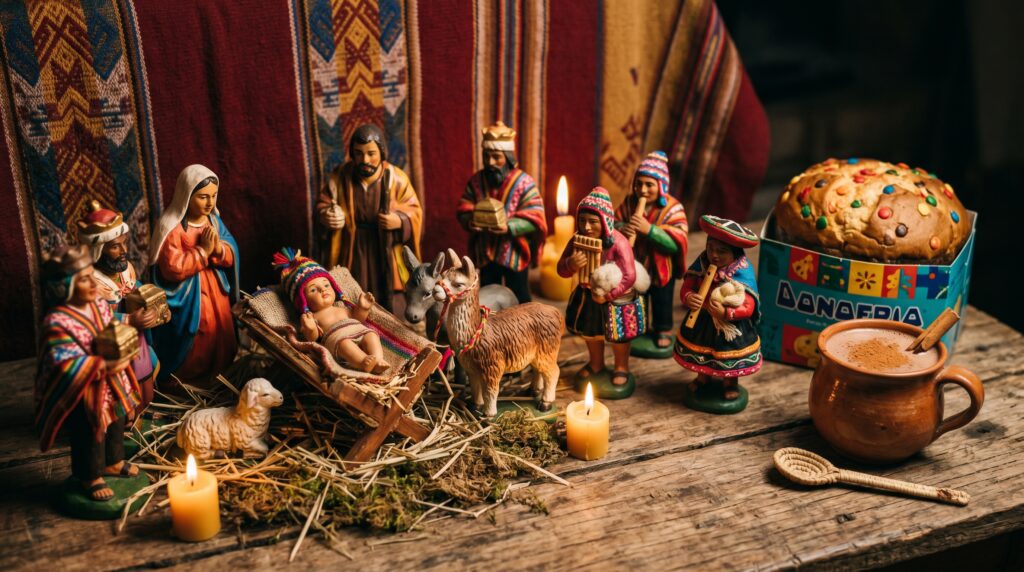
This one’s special. In Peru, the baby Jesus figure in the nativity scene is called Niño Manuelito. And he doesn’t look like the standard European baby Jesus. He’s often dressed in traditional Andean clothing. A tiny chullo (that’s the Peruvian knit hat with earflaps). Sometimes a little poncho.
Most Peruvian families have a Niño Manuelito figure that’s been in the family for years. It comes out December 1 and stays out until February 2. Some people swap his outfit a few times during the season.
The food. Honestly, this is the main event.
Look, every culture has its Christmas food. Peru’s food is really good. Here’s what shows up on basically every family table on December 24.
Pavo navideño (the Christmas turkey)
The centerpiece is roasted turkey. Same idea as a Thanksgiving turkey, but the seasonings are different. We use aji panca (that’s a smoky red Peruvian pepper paste), a lot of garlic, soy sauce, and some other spices. Most families marinate the turkey for a day or two before cooking it. The whole house smells like garlic and aji for two days. And it’s served with apple sauce, applesauce stuffing, and some fruit-based sides.
Panetón (this one’s a big deal)
Panetón is the iconic Peruvian Christmas food. It’s a tall sweet bread with candied fruits and raisins. Originally Italian (panettone), brought to Peru by Italian immigrants over 100 years ago. But it’s fully Peruvian now.
D’Onofrio is the most famous brand. You’ll see those colorful boxes in every grocery store in Peru from October through January. Other big ones are Gloria, Todinno, and Motta. Most families have at least one panetón sitting on the counter the whole month of December. And on Christmas Eve, you eat a slice with hot chocolate. That’s the combo.
Hot chocolate (with milk, cinnamon, the whole thing)
Peruvian Christmas hot chocolate isn’t just cocoa powder and water. It’s real cocoa, hot milk, cinnamon, sometimes a few cloves, sometimes a little evaporated milk to make it thicker. It’s warm, sweet, and a little spiced. And like I said above, you drink it with panetón.
Honestly, if you wanted to do one Peruvian Christmas thing this year and only one thing, this would be it. Make real hot chocolate from scratch. Slice up a panetón. That’s the moment.
Tamales (the savory kind)
In a lot of Peruvian households, especially on the coast, you’ll also see tamales on Christmas Eve. These are heavier and more savory than the Mexican ones a lot of Americans know. Corn or rice masa, pork or chicken inside, wrapped in plantain leaves, steamed. Usually served as a starter before the turkey.
Side dishes and sweets
Other things you’ll see on the table: arroz arabe (Arabic rice with raisins, almonds, and noodles, a weirdly common Peruvian dish), apple sauce, ensalada rusa (Russian salad with potatoes, peas, carrots, and mayo). For dessert, beyond the panetón, you might get suspiro a la limeña or manjar blanco-filled pastries.
Want a piece of Peru on your table this year?
If you’re hosting a Christmas dinner and you want one thing that nods to Peruvian craft, even a small piece works. A hand-carved sculpture as a centerpiece. A small Cusco leather pouch as a gift bag. Stuff that has a story. Our Christmas Gifts collection has the pieces that work for that.
Decorations: nacimientos, retablos, and the Christmas tree
Peruvian Christmas decorations are some of the most beautiful in the world. And the centerpiece isn’t the tree. It’s the nativity scene.
The nacimiento (this is bigger than the tree)
In Peru, the nacimiento (nativity scene) is the most important Christmas decoration in the house. It’s not just the standard Mary, Joseph, baby Jesus, and the three Wise Men. A Peruvian nacimiento has dozens of figures. Shepherds. Llamas. Alpacas. Andean villagers in traditional clothing. Indigenous musicians. The whole village comes to see the baby.
Most families build their nacimiento over years. You buy a few figures one Christmas. Add more the next year. By the time you’re an adult, you’ve got 30 or 40 pieces, and putting up the nacimiento takes an afternoon.
Retablos from Ayacucho
A retablo is a small wooden box that opens up to reveal a whole scene inside. Religious figures, made from molded ceramic, painted by hand. Retablos are the signature craft of Ayacucho, a region in the south-central Andes. The most famous artisan families there have been doing it for hundreds of years. A good handmade retablo can take a master craftsperson weeks. If you want one really authentic Peruvian Christmas piece, a retablo is the move.
Hand-carved wooden ornaments
A lot of Peruvian households have hand-carved wooden ornaments hanging from the tree or sitting on shelves. Llamas. Andean musicians. Tiny chullo-wearing figurines. Painted in bright traditional colors. They’re affordable, they travel well, and they make really good gifts.
Yes, we also have a Christmas tree
Christmas trees came to Peru with European immigrants over a century ago, and now most families have one. It’s usually artificial because real evergreens are rare in most of Peru. The tree gets decorated with a mix of imported ornaments and handmade Peruvian pieces. And the nacimiento is set up at the base of the tree.
The music sounds different. Here’s why.
Peru has its own Christmas music tradition. Beyond the same global Christmas songs you hear on the radio everywhere, Peru has villancicos. These are Peruvian Christmas carols, sung in Spanish, Quechua, or both, often with traditional Andean instruments like the charango (small string instrument), quena (bamboo flute), or zampoña (pan flute).
Andean villancicos
Up in the Andes, around Cusco and Puno and Ayacucho, villancicos are often sung in Quechua. Or a mix of Quechua and Spanish. The melodies are built on top of the traditional huayno rhythm, which is the native music of the region. So the result is Christmas carols that sound nothing like “Silent Night.” They sound like the Andes.
Songs you’ll hear
Some of the famous Peruvian villancicos are “Niño Manuelito,” “Hatun Apu Yaya,” “Cantemos un Villancico,” and “Yo Soy Vicentico.” Kids learn them in school. They get sung at Christmas Eve gatherings. There’s even a famous scene in the movie “Christmas with the Kranks” (2004) where a Peruvian Christmas song plays, which is one of the few times mainstream American media has shown a piece of Peruvian Christmas music.
Santurantikuy in Cusco
If you want to see the most concentrated, real-deal Peruvian Christmas experience, go to Cusco on December 24. The central plaza turns into a giant Christmas market called Santurantikuy. The name means “buying of saints” in Quechua. Artisans come from all over the southern Andes to sell handmade nativity figures, retablos, ornaments. Live villancicos in the background. It’s been going on for centuries.
The Andean roots underneath it all
Peruvian Christmas has Catholic roots from the Spanish, sure. But underneath that, there’s a much older Andean tradition that never went away.
In Quechua-speaking communities, the baby Jesus wears Andean clothing. The villancicos are in Quechua. The nativity scene has llamas and alpacas instead of donkeys and sheep. December also lands close to Capac Raymi, the Inca December solstice festival that celebrated the sun at its strongest point and was the second-biggest religious celebration of the Inca year. So when Catholic Christmas was introduced after Spanish colonization, the older indigenous celebratory energy from Capac Raymi got blended into how Andean communities celebrate Christmas today.
This blending isn’t new. It happened starting in the 1500s, right when Spanish missionaries arrived and indigenous artisans started making their own versions of European religious imagery using local materials. The result is what you see today: a Christmas that’s Catholic on the surface and Andean underneath.
How to say Merry Christmas in Peru
In Spanish, the standard greeting is “Feliz Navidad” (Merry Christmas). For something a little fuller, “Feliz Navidad y Próspero Año Nuevo” means Merry Christmas and a Prosperous New Year.
In Quechua (the indigenous language spoken by millions of Peruvians in the highlands), you’d say “Sumaq Pascua” or “Allin Pascuata.” These both basically mean “good Christmas.”
In Aymara, spoken around Lake Titicaca, the greeting is “Suma Phaxsi Marani,” which means “good holiday season.”
If you’re sending a card to a Peruvian friend or family member, just “Feliz Navidad” is perfect. If you want to go further and show you know the culture, throw in a “Sumaq Pascua.” They’ll appreciate it.
Christmas gifts in Peru: midnight, not morning
Gift exchange happens at midnight on December 24. After the fireworks. After the family hugs. That’s when the kids run to the tree. Christmas morning isn’t a big deal in Peru. The big moment is the night before, around midnight.
Peruvian gift culture tends to be more personal than commercial. Handmade things matter. Pieces with a story matter. For Peruvians living abroad (like me), getting or sending an authentic piece from Peru during Christmas is a way of staying connected to home.
Bringing some of Peru into your Christmas
You don’t have to be Peruvian, or have been to Peru, to bring a piece of this into your holiday. The pieces themselves carry the story.
A hand-carved leather bag with an Andean textile panel sewn into the front. A hand-carved Machu Picchu sculpture on your mantel year-round, not just December. A bull horn flask that becomes a conversation piece every time you bring it out. Stuff like that.
Every piece we sell is made by hand by artisans in Cusco and the surrounding Andean highlands. No factories. No mass production. The same craftspeople you’d meet at Santurantikuy in Cusco are the ones who made the pieces we ship to your door.
Want to give a gift with a real story this year?
Here’s a few collections that might fit:
- Christmas Gifts — pieces that work as holiday gifts
- Peruvian Souvenirs — for anyone who’s been to Peru or wants to go
- Handmade Gifts — everything we sell is in here
- Machu Picchu Statues — hand-carved sculptures of the Inca city
- Bull Horn Crafts — pipes, flasks, and decor pieces
Free US standard shipping on orders $50+. Worldwide shipping available. If you’ve got a question, just email us at info@craftedinperu.com.
Peruvian Christmas FAQ
When do Peruvians actually celebrate Christmas?
December 24, late at night. Most families do dinner around 10 or 11 PM. At midnight, fireworks, hugs, and gifts. December 25 is more of a recovery day.
What are the most important Peruvian Christmas foods?
Two essentials: pavo navideño (Christmas turkey) and panetón (Peruvian panettone). The turkey is the main dish. The panetón with hot chocolate is the dessert. That combo is non-negotiable.
Do Peruvians have a Christmas tree?
Yes. Almost every household has one, usually artificial. But the nativity scene (nacimiento) is actually more important than the tree.
What’s Niño Manuelito?
It’s the specifically Peruvian version of the baby Jesus, often shown in Andean clothing like a chullo (knit hat) or a small poncho. He’s the centerpiece of most Peruvian family nativity scenes.
How do you say Merry Christmas in Peru?
In Spanish: “Feliz Navidad.” In Quechua: “Sumaq Pascua” or “Allin Pascuata.” In Aymara: “Suma Phaxsi Marani.”
What’s Santurantikuy?
Santurantikuy is the biggest Christmas artisan market in South America, held in Cusco’s central plaza on December 24. Artisans from across the southern Andes come to sell handmade nativity figures, retablos, and ornaments. Live villancicos play in the background. If you ever get the chance to go, do it.
What’s a retablo?
A small wooden box that opens up to reveal a religious scene built from molded ceramic figures. Retablos are the signature folk craft of Ayacucho. They’re one of the most authentic pieces of Peruvian Christmas art you can own.
Whether you’re in Lima or Charlotte, Feliz Navidad
That’s it. That’s the whole picture of a Peruvian Christmas. Family. Late dinner. Fireworks at midnight. Hot chocolate and panetón. Songs in Quechua. Nativity scenes with llamas. The whole thing.
If you want to bring a piece of it into your own holiday, our Christmas Gifts collection is the place to start. Or just put on some Peruvian villancicos and make some hot chocolate. That works too.
Feliz Navidad from all of us at Crafted In Peru.